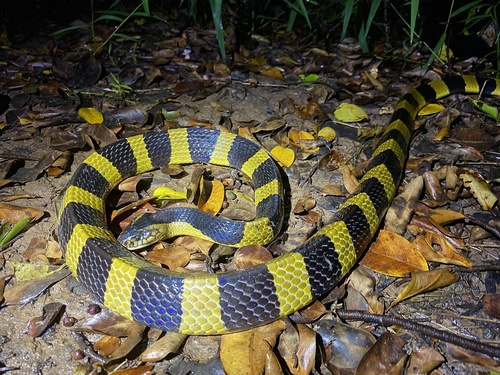
Banded Krait
Bungarus fasciatus
Decked in unmistakable bands of gold and charcoal, the Banded Krait is a shy nocturnal giant of the Asian tropics. Though its venom is legendary, this gentle-natured serpent is a vital part of the ecosystem, specializing in the hunt of other snakes.
Quick Identification
Size
Length: 1.5 to 2.1 metres (5 to 7 feet); Weight: 1 to 2 kg (2.2 to 4.4 lbs)
Colors
Alternating bold bands of black and yellow or gold; black head with a prominent yellow V-shaped mark
Key Features
- Alternating thick black and yellow rings that encircle the entire body
- Distinctive triangular cross-section with a ridged spine
- Blunt, rounded tail tip that looks like a second head
- Broad black head with a distinctive yellow 'V' or 'Y' marking
When You’ll See Them
Geographic range
Where Does the Banded Krait Live?
The Banded Krait is native to the diverse landscapes of South and Southeast Asia, spanning from the fertile plains of the Indian subcontinent through the humid jungles of the Indochinese Peninsula and down into the Malay Archipelago. Its core range includes countries like India, Bangladesh, Thailand, and Vietnam, and extends north into Southern China. Typically found in lowland areas, this adaptable serpent thrives near water sources and agricultural fields, often living in close proximity to human settlements without being seen.
Basemap © OpenStreetMap contributors
Behavior
The Banded Krait is a primarily nocturnal specialist, known for its extreme shyness during daylight hours. While many venomous snakes are quick to strike, this species is surprisingly lethargic when exposed to sun, often tucking its head beneath its body to avoid light and confrontation. At night, however, it transforms into an active and efficient predator, moving gracefully through damp leaf litter and tall grass.
Its relationship with humans is complex; while its neurotoxic venom is potentially fatal, the snake is not naturally aggressive and will almost always choose flight over fight. Most encounters occur in rural or suburban areas near water, where the snake patrols for its preferred prey: other snakes. Because it frequently inhabits agricultural land, it provides a natural form of pest control by keeping other serpent populations in check.
EverydayEarth exclusive
Camera Tips
To capture high-quality footage of the Banded Krait, place your camera as close to the ground as possible, ideally no more than 6 to 10 inches high. These snakes are ground-dwellers that rarely climb, so a low-angle shot will provide the best view of their striking banded pattern and unique triangular body shape. Position your equipment near potential 'snake highways' such as the base of garden walls, along irrigation ditches, or the perimeter of dense woodpiles where they search for prey.
Since this species is strictly nocturnal, your camera must have high-quality infrared (IR) or 'no-glow' night vision capabilities. Standard white flashes can startle the snake and cause it to flee, whereas IR allows you to observe its natural foraging behavior undisturbed. Set your camera to record short video clips (15-30 seconds) rather than still photos; this helps you identify the snake's distinctive, slow-moving undulation and its habit of frequent tongue-flicking to 'scent' its surroundings.
Banded Kraits are most active during humid conditions, particularly during the monsoon season or immediately after heavy evening rain. Setting up your camera near a permanent water source like a garden pond, a damp drainage pipe, or even a leaky outdoor tap can significantly increase your chances of a sighting. In suburban environments, they are often drawn to the same areas as rodents, which in turn attract the smaller snakes that kraits feed upon.
Always prioritize safety when checking your camera in known krait territory. Because these snakes are incredibly difficult to spot in the dark and may be resting near your equipment, always carry a powerful flashlight and wear thick, ankle-high boots. Never reach into tall grass or under the camera housing without first verifying the area is clear.
Similar Species
Species that look similar or are commonly confused with Banded Krait.
Malayan Krait
Has black and white bands instead of yellow, and lacks the blunt, rounded tail of the Banded Krait.
Many-banded Krait
Features much thinner white bands on a black body and lacks the distinctive triangular body ridge.
Banded Wolf Snake
A non-venomous mimic with a slender, cylindrical body and a pointed snout, lacking the ridged spine and yellow 'V' head mark.
Frequently Asked Questions
Record Banded Krait at your habitat
Connect a camera to start building your own species record — AI identifies every visitor automatically.