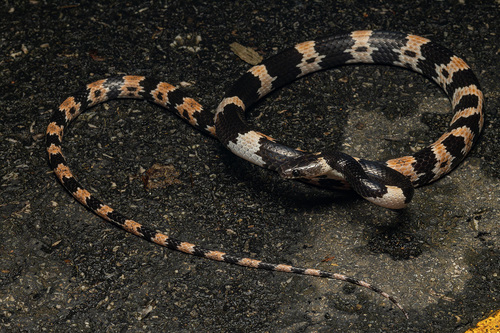
Banded Wolf Snake
Lycodon fasciatus
A striking nocturnal hunter of the Asian highlands, the Banded Wolf Snake is a master of mimicry and an expert climber. Though often mistaken for its venomous look-alikes, this harmless species is a fascinating garden guest for any backyard naturalist.
Quick Identification
Size
60–100 cm (24–39 inches) in length; typically slender with a slightly flattened head.
Colors
Glossy black or dark purplish-brown base with 25–50 prominent cream, yellow, or white crossbands that broaden on the sides.
Key Features
- Enlarged front teeth for gripping slippery prey
- Flattened 'spatulate' snout
- Boldly banded pattern mimicking venomous kraits
- Large eyes with vertical pupils
- Slender, slightly compressed body
When You’ll See Them
Geographic range
Where Does the Banded Wolf Snake Live?
Native to the diverse landscapes of South and Southeast Asia, the Banded Wolf Snake is primarily a species of the hills and mountains. Its core range extends from Northeast India and Bhutan through the highlands of Myanmar and into Southern China. It is also frequently encountered in the lush, moisture-rich forests of Thailand, Laos, and Vietnam, where it thrives in both primary jungle and disturbed habitats near human settlements.
Basemap © OpenStreetMap contributors
Behavior
The Banded Wolf Snake is a secretive, nocturnal hunter that spends its daylight hours tucked away in rock crevices, hollow logs, or beneath leaf litter. It is an exceptionally agile climber, often seen scaling vertical surfaces or navigating the rafters of rural buildings in search of its favorite prey: geckos. Despite its somewhat intimidating name, the 'wolf' moniker simply refers to its enlarged front teeth, which are specialized for grasping the smooth, slippery scales of lizards.
When confronted, the Banded Wolf Snake is generally timid but can become defensive if it feels cornered. It often employs a strategy of Batesian mimicry; its striking black-and-yellow bands closely resemble the highly venomous Many-banded Krait, which discourages many would-be predators. While it may strike if handled, it is non-venomous and poses no serious threat to humans, making it a beneficial neighbor for controlling garden pest populations.
EverydayEarth exclusive
Camera Tips
To capture high-quality footage of the Banded Wolf Snake, your camera placement should focus on 'travel corridors' and lizard hotspots. Look for stone retaining walls, wood piles, or the foundations of outbuildings where house geckos congregate. Positioning your camera just 6 to 12 inches off the ground, angled slightly downward toward a flat surface or a known hiding spot, will provide the best profile shots. Using a camera with a short focal length or 'macro' capability is ideal, as these snakes are relatively small and detail-oriented.
Because they are strictly nocturnal, you must use a camera with high-quality infrared (IR) or 'No-Glow' LEDs. Traditional white flashes may startle the snake, causing it to flee before you get a second frame. Ensure your PIR (Passive Infrared) sensor sensitivity is set to 'High.' Since snakes are ectothermic (cold-blooded), they don't always trigger sensors as easily as mammals do; a higher sensitivity setting helps the camera detect the slight temperature difference between the snake and the ground.
If you are setting up in a backyard, place the camera near an outdoor light source that stays on after dark. While the snake isn't attracted to the light itself, it is highly attracted to the moths and geckos that gather there. The best time of year for sightings is during the monsoon or rainy season when humidity is high and the snakes are most active. Avoid placing cameras in direct wind, as moving vegetation can create 'false triggers' that fill your SD card before the snake arrives.
Similar Species
Species that look similar or are commonly confused with Banded Wolf Snake.
Many-banded Krait
The Krait is highly venomous, has round pupils, and a ridge of enlarged hexagonal scales running down its spine.
Common Wolf Snake
The Common Wolf Snake (L. aulicus) usually has less distinct white or yellow bands that often fade or become blotchy toward the tail.
Malayan Krait
The Malayan Krait has a distinct triangular body shape in cross-section and its bands wrap entirely around the belly, whereas the wolf snake's bands may vary.
Frequently Asked Questions
Record Banded Wolf Snake at your habitat
Connect a camera to start building your own species record — AI identifies every visitor automatically.