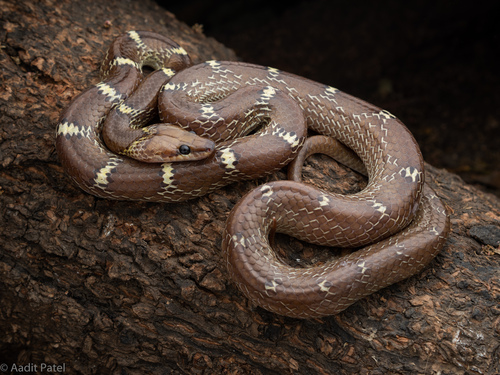
Indian Wolf Snake
Lycodon aulicus
A sleek, nocturnal hunter and master climber, the Indian Wolf Snake is a frequent but often unseen guest in South Asian backyards. Though it mimics the deadly krait for protection, this harmless reptile is a beneficial neighbor that keeps local lizard populations in check.
Quick Identification
Size
30–70 cm (12–28 inches) in length; rarely exceeds 80 cm (31 inches)
Colors
Glossy chocolate brown or greyish-black with 12-19 white or yellowish crossbands that widen at the flanks; belly is plain white or cream.
Key Features
- Flattened spatula-shaped head broader than the neck
- White or yellow 'collar' marking on the nape
- Glossy, smooth scales without keels
- Prominent, enlarged front teeth used for gripping slippery lizards
- Vertical pupils similar to a cat's eye
When You’ll See Them
Geographic range
Where Does the Indian Wolf Snake Live?
Native to the South Asian subcontinent and parts of Southeast Asia, the Indian Wolf Snake is one of the most widely distributed reptiles in its region. Its core range spans across India, Pakistan, Sri Lanka, Bangladesh, and Nepal, while it also thrives in Myanmar and Thailand. Because of its fondness for human dwellings, it has successfully established introduced populations on various islands, including the Maldives, Mauritius, and Reunion.
Basemap © OpenStreetMap contributors
Behavior
The Indian Wolf Snake is a predominantly nocturnal hunter, becoming active shortly after dusk to search for its favorite prey. Despite its somewhat fearsome name, it is nonvenomous and generally shy around humans. However, if it feels cornered or is handled roughly, it can be quite feisty, often vibrating its tail and striking repeatedly. Its bite is harmless to humans but can be painful due to its long, needle-like teeth, which it evolved to grip the smooth scales of lizards.
This species is a phenomenal climber, often seen scaling vertical brick walls or moving through roof rafters with ease. This arboreal ability allows it to hunt geckos in places other predators can't reach. During the day, it retreats into dark, cool crevices, such as stone piles, hollow trees, or even behind furniture and inside wall cracks in suburban homes. Interestingly, it is a classic example of Batesian mimicry, as its banded pattern closely resembles the highly venomous Common Krait, a tactic that helps deter potential predators.
EverydayEarth exclusive
Camera Tips
To capture high-quality footage of an Indian Wolf Snake, you must focus on the 'ground-level highways' they use. Place your AI camera very low to the ground—no more than 4 to 6 inches high—and angle it slightly downward. These snakes love to hug the edges of structures, so position the lens along the base of a garden wall, a rock pile, or near the foundation of an old shed. Because they are slender, ensure your camera's PIR (motion) sensitivity is set to 'High' to detect their smaller heat signature and movement.
Since these snakes are strictly nocturnal, your camera’s infrared (IR) performance is critical. Look for a model with 'No-Glow' IR to avoid startling the snake or attracting unwanted attention to the camera. If you are using an EverydayEarth AI camera, try to set a focal lock if possible, as these snakes are small and can appear blurry if the camera focuses on the background instead of the subject moving across the foreground.
An expert trick for attracting the Indian Wolf Snake is to attract its food. Placing a small, low-wattage light near your camera (but out of the frame) will attract moths and insects, which in turn attract geckos. Where there are geckos, the Wolf Snake will eventually follow. Focus your camera on the transition zone between a dark hiding spot and the illuminated 'hunting ground.' In suburban settings, the area near an outdoor drain or a stack of terracotta pots is often a hotspot during the humid monsoon months.
Similar Species
Species that look similar or are commonly confused with Indian Wolf Snake.
Common Krait
The Krait is highly venomous with hexagonal scales along its spine and white bands that usually appear as narrow pairs.
Travancore Wolf Snake
Identified by yellow crossbars that do not widen on the sides and a more restricted range in the Western Ghats.
Banded Kukri Snake
Features distinct chevron-shaped markings on the head and a much thicker, stouter body.
Frequently Asked Questions
Record Indian Wolf Snake at your habitat
Connect a camera to start building your own species record — AI identifies every visitor automatically.