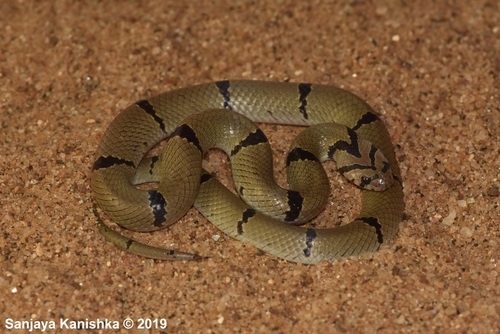
Banded kukri snake
Oligodon arnensis
A master of the garden undergrowth, the Banded Kukri Snake is a beautiful, non-venomous reptile known for its striking patterns and specialized egg-eating habits.
Quick Identification
Size
Typically 35–60 cm (14–24 inches) in length; maximum reach of about 75 cm (30 inches).
Colors
Pale brown or greyish-tan base with 20–30 prominent dark brown or black crossbands; head features three distinct dark 'V' or arrowhead-shaped marks.
Key Features
- Distinct 'V' or 'Λ' markings on the top of the head
- 20-30 bold dark crossbands along the body
- Smooth, glossy scales with a thick-set appearance
- Short, blunt head barely wider than the neck
When You’ll See Them
Geographic range
Where Does the Banded kukri snake Live?
The Banded Kukri Snake is a quintessential South Asian species, calling much of the Indian subcontinent home. It is found natively throughout India, Sri Lanka, Pakistan, Nepal, and Bangladesh, thriving in a variety of landscapes from tropical lowlands to the foothills of the Himalayas. Because it adapts well to human-modified environments, it is one of the more common snakes to encounter in South Asian urban gardens and rural farmsteads.
Basemap © OpenStreetMap contributors
Behavior
The Banded Kukri Snake is a secretive and primarily terrestrial reptile. It derives its name from its specialized rear teeth, which are broadened and curved like a 'Kukri'—the traditional Nepalese knife. These teeth are not for delivering venom, as the snake is non-venomous, but are instead used to slit the shells of reptile eggs, which are a primary component of its diet. When threatened, this snake may flatten its body or coil tightly, and while it is generally docile, it will not hesitate to deliver a defensive bite if handled.
Unlike many other small snakes, the Banded Kukri Snake is quite comfortable living in close proximity to humans. It is often found in the nooks and crannies of old masonry, garden walls, or under leaf litter in suburban backyards. While it is predominantly crepuscular, meaning it is most active during the twilight hours of dawn and dusk, it can occasionally be seen foraging at night or on overcast days during the monsoon season.
EverydayEarth exclusive
Camera Tips
To capture a Banded Kukri Snake on camera, your best bet is to focus on 'threshold' areas in your garden. These snakes love the vertical-to-horizontal transition zones—where a stone wall meets the soil or where a pile of bricks sits on the grass. Position your camera very low to the ground, no more than 2 to 4 inches high, and angle it slightly downward to capture the detail of the snake's dorsal bands, which are essential for a positive ID.
Because these snakes are relatively small and move with a steady, rhythmic crawl, use a camera with a fast trigger speed and a high-sensitivity PIR (passive infrared) sensor. If your camera allows for 'focal tuning,' set it for a close-range focus (1-3 feet). Since they are most active during the monsoon months, ensure your camera housing is fully waterproof and placed in a location where water doesn't pool, which could obscure the lens or drown the electronics.
You can encourage a visit by maintaining a small rock pile or 'reptile hotel' in a quiet corner of the yard. These snakes are often hunting for the eggs of garden lizards (like calotes), so placing your camera near areas where lizards are known to congregate can increase your chances. For night captures, ensure your IR flash isn't too powerful at close range, as it can 'wash out' the snake's pale scales, making the bands hard to see in the footage.
Similar Species
Species that look similar or are commonly confused with Banded kukri snake.
Frequently Asked Questions
Record Banded kukri snake at your habitat
Connect a camera to start building your own species record — AI identifies every visitor automatically.