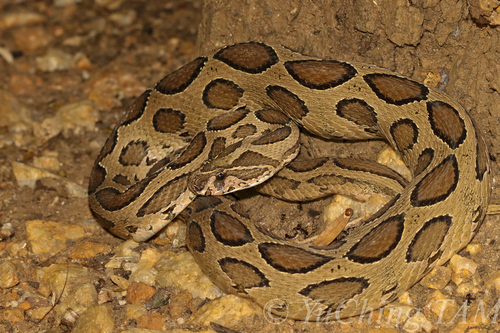
Russell's Viper
Daboia russelii
South Asia's most famous ambush predator, the Russell's Viper, is easily recognized by its beautiful chain-link pattern and its fearsome, pressure-cooker hiss.
Quick Identification
Size
Typically 90-125 cm (3-4 ft) in length, though large specimens can reach up to 166 cm (5.5 ft). They are thick-bodied and heavy for their length.
Colors
Tan, brown, or yellowish-brown base with three longitudinal rows of dark brown spots. Each spot is outlined with a black ring and a thin white or yellow border, creating a chain-like appearance.
Key Features
- Distinctly triangular, flat head much wider than the neck
- Three rows of dark brown, chain-link oval spots along the body
- Large, prominent nostrils and a blunt, slightly upturned snout
- Heavily keeled scales that give the snake a rough, non-glossy texture
When You’ll See Them
Geographic range
Where Does the Russell's Viper Live?
Russell's Viper is native to the South Asian subcontinent, maintaining a vast and continuous range across India, Pakistan, Sri Lanka, Bangladesh, and Nepal. While it is a lowland specialist, it can be found in the foothills of the Himalayas and the rolling hills of the Western Ghats. This adaptable predator thrives in the fertile plains of the Ganges and Indus rivers but is notably absent from dense rainforests and extremely arid deserts, preferring the 'middle ground' of scrub and farmland.
Basemap © OpenStreetMap contributors
Behavior
The Russell's Viper is a primarily nocturnal hunter, though it may be seen basking during the day in cooler weather. It is famously lethargic and slow-moving until threatened; however, when provoked, it becomes one of the most aggressive snakes in the world. It coils into a tight 'S' shape and emits a piercingly loud hiss—often compared to the sound of a pressure cooker—which serves as a final warning before a lightning-fast strike.
Unlike many other vipers that strike and release, the Russell's Viper may hang on to its prey to deliver a massive dose of venom. While they generally avoid human contact, their preference for rodents often brings them into close proximity with agricultural areas and suburban gardens, leading to frequent human-wildlife encounters. They are terrestrial snakes, meaning they spend almost all their time on the ground rather than in trees or water.
EverydayEarth exclusive
Camera Tips
To capture high-quality footage of a Russell's Viper, camera placement is everything. These are heavy, ground-dwelling snakes, so your camera must be mounted no more than 6-10 inches off the ground. Aim the lens slightly downward to cover the forest floor or a field edge. Look for natural funnels, such as the gap between a rock and a wall, or along the edges of agricultural grain stores where rodents congregate. Their movement is slow and deliberate, so set your PIR (Passive Infrared) sensor to high sensitivity to ensure the cold-blooded reptile triggers the shutter.
Because they are most active at night, a camera with 'No-Glow' or 'Black Flash' infrared LEDs is essential. Standard red-glow LEDs can sometimes startle the prey they are stalking, which might spoil a natural hunting sequence. Using video mode rather than still photos is highly recommended; the slow, undulating movement of a large viper is far more impressive and easier to identify on film than in a blurry night-time photo. Set your video length to at least 20 seconds to capture the full transit of the snake across the frame.
Safety is paramount when checking cameras in Russell's Viper territory. Never reach into long grass or under a camera housing with your bare hands, especially at night. Always use a flashlight and wear thick, knee-high boots when servicing your equipment. Since these snakes are attracted to rodent activity, placing your camera near woodpiles or compost heaps in a backyard setting often yields the best results during the monsoon season when the snakes are most active.
Similar Species
Species that look similar or are commonly confused with Russell's Viper.
Frequently Asked Questions
Record Russell's Viper at your habitat
Connect a camera to start building your own species record — AI identifies every visitor automatically.