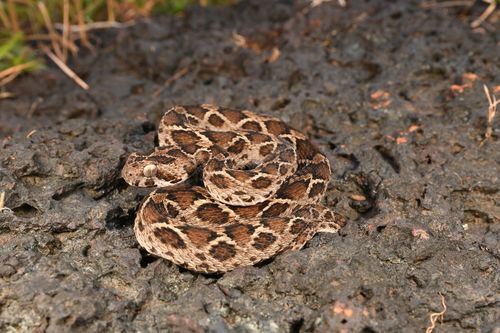
Saw-scaled Viper
Echis carinatus
The Saw-scaled Viper may be small, but it is one of the world's most formidable predators. Known for its 'sandpaper' hiss and lightning-fast strike, this master of camouflage is a fascinating subject for backyard wildlife observers in arid regions.
Quick Identification
Size
A small, stout viper typically ranging from 38 to 80 cm (15 to 31 inches) in length, weighing between 100 and 450 grams.
Colors
Base colors range from sandy gray to reddish-brown with a series of pale, dark-edged patches or a zig-zag pattern along the back; the belly is usually white with dark spots.
Key Features
- Distinctive 'arrow' or 'bird-foot' mark on top of the head
- Keeled, 'saw-like' scales that rasp together when threatened
- Stout body with a pear-shaped head wider than the neck
- Vertical, slit-like pupils
When You’ll See Them
Geographic range
Where Does the Saw-scaled Viper Live?
The Saw-scaled Viper is native to the vast arid regions of the Old World, stretching from the Middle East through Central Asia to the Indian subcontinent. It is most densely populated across India, Pakistan, and Sri Lanka, but its core range also includes Oman, the United Arab Emirates, and parts of Iran. These vipers are highly adaptable and are frequently found near human settlements, particularly in rural and semi-urban areas where rodents are plentiful.
Basemap © OpenStreetMap contributors
Behavior
The Saw-scaled Viper is renowned for its unique defensive display known as stridulation. When threatened, it coils into a series of C-shaped loops and rubs its keeled scales together, producing a loud, rasping hiss that sounds like sandpaper being rubbed or water boiling. Unlike many other snakes that flee when approached, this species is known for its irritable temperament and will strike quickly if it feels cornered.
These snakes are primarily nocturnal, though they may bask in the sun during cooler months. They are masters of camouflage, often burying themselves in loose sand or hiding under rocks and leaf litter. One of their most striking behaviors is 'sidewinding'—a specialized form of locomotion that allows them to move efficiently across hot, loose sand while minimizing body contact with the ground.
EverydayEarth exclusive
Camera Tips
To capture a Saw-scaled Viper on camera, placement is everything. These are ground-dwelling snakes that frequent dry stone walls, rock piles, or the edges of thorny thickets. Position your camera just 10–15 centimeters (4–6 inches) off the ground, angled slightly downward. Focus on areas where the snake might seek shelter during the day or hunt at night, such as near outdoor lights that attract the insects and lizards they prey upon.
Since these vipers are primarily nocturnal, you will need a camera with excellent infrared (IR) night vision capabilities. Because their scales are highly reflective and textured, standard white-flash cameras can sometimes 'wash out' the intricate patterns that help with identification. Using a 'No-Glow' IR camera is preferable to avoid startling the snake or attracting unwanted attention to your equipment in public-facing areas.
Safety is the most critical consideration when dealing with this species. The Saw-scaled Viper is one of the 'Big Four' venomous snakes in South Asia and is responsible for more bites than almost any other species. Never attempt to move or pose the snake for a shot. Use long-term setups with large memory cards so you only have to check the camera every few weeks, and always wear thick, protective boots and use a flashlight when walking to your camera site after dark.
Similar Species
Species that look similar or are commonly confused with Saw-scaled Viper.
Frequently Asked Questions
Record Saw-scaled Viper at your habitat
Connect a camera to start building your own species record — AI identifies every visitor automatically.