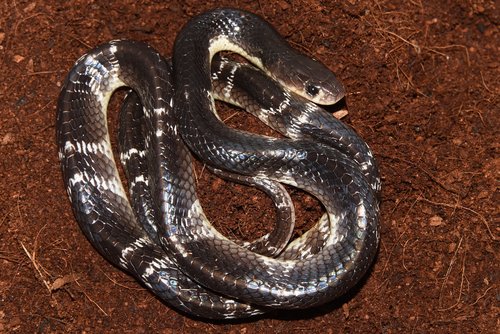
Common Krait
Bungarus caeruleus
The Common Krait is a master of the midnight shadows, a glossy black predator known for its stealth and potent venom. While shy by day, this elusive snake is a fascinating subject for nocturnal wildlife monitoring across South Asia.
Quick Identification
Size
90 to 120 cm (3 to 4 feet) on average, with exceptionally large individuals reaching 175 cm (5 feet 9 inches).
Colors
Glossy black, deep steel blue, or dark chocolate brown with thin, white crossbands that often appear in pairs and become more prominent toward the tail.
Key Features
- Distinctive enlarged hexagonal scales running along the spine
- Narrow white crossbands on a dark, highly glossy body
- Small, dark eyes with round pupils and a blunt snout
- Cylindrical body shape with a short, tapering tail
When You’ll See Them
Geographic range
Where Does the Common Krait Live?
The Common Krait is native to the South Asian subcontinent, where it maintains a massive and stable population. Its core range spans the entirety of India—from the Himalayan foothills to the southern plains—as well as Pakistan, Sri Lanka, Bangladesh, and Nepal. While it is primarily a lowland specialist, it is remarkably adaptable to various environments, provided there is enough moisture and a steady supply of prey.
Basemap © OpenStreetMap contributors
Behavior
Known as one of the 'Big Four' venomous snakes of South Asia, the Common Krait is notoriously shy and lethargic during the day. It spends its daylight hours concealed in termite mounds, rodent burrows, or under thick leaf litter to avoid the heat. When disturbed during the day, it is remarkably docile, often coiling its body and hiding its head to avoid confrontation.
However, the Common Krait undergoes a dramatic personality shift at night. As a strictly nocturnal hunter, it becomes alert, agile, and significantly more dangerous. It is known to wander into human settlements and even enter homes in search of warmth or prey, making it a significant medical concern in rural and suburban areas. Despite its potent venom, it is not naturally aggressive and typically only bites when stepped on or provoked in the darkness.
EverydayEarth exclusive
Camera Tips
To capture the Common Krait on a backyard camera, placement is everything. These snakes are 'edge hunters,' meaning they prefer to travel along vertical landmarks. Position your camera just 10-15 cm (4-6 inches) off the ground, angled along the base of a garden wall, a woodpile, or the foundation of a shed. They rarely cross wide-open spaces, so focusing on these linear corridors is your best bet for a clear shot.
Because the Common Krait is strictly nocturnal, your camera’s infrared capabilities are critical. Use a 'No-Glow' or 'Black IR' flash to ensure you don't startle the snake, which might cause it to flee the frame. Set your camera to a high-sensitivity motion trigger and use a short video mode (10-15 seconds). Their movement is often slow and rhythmic, so a video clip captures their unique undulating gait much better than a single still photo.
Safety is paramount when working in Krait territory. Never attempt to use food lures to attract them, as this creates a safety hazard for you and your neighbors. Instead, place cameras near natural attractants like damp areas that host frogs or known rodent paths. When checking your SD cards, always wear sturdy boots and use a long stick to inspect the area around the camera before reaching down, as Kraits are masters of camouflaging themselves in leaf litter and debris.
Similar Species
Species that look similar or are commonly confused with Common Krait.
Frequently Asked Questions
Record Common Krait at your habitat
Connect a camera to start building your own species record — AI identifies every visitor automatically.