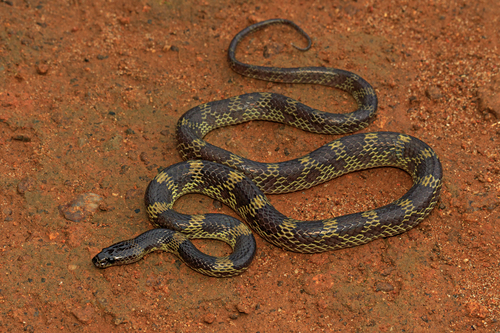
Travancore Wolf Snake
Lycodon travancoricus
A sleek, nocturnal hunter endemic to the hills of South India, the Travancore Wolf Snake is a master of the night. Often found in gardens and plantations, this non-venomous climber is a fascinating neighbor for those living near the Western Ghats.
Quick Identification
Size
45–60 cm (18–24 inches) on average; can reach up to 75 cm (30 inches)
Colors
Glossy chocolate brown or jet black with thin yellow or white crossbars that split on the flanks; belly is uniform cream or white.
Key Features
- Glossy dark body with thin, pale crossbars
- Crossbars bifurcate (split) on the sides of the body
- Broad, flattened head distinct from the neck
- Large, watchful eyes with vertical pupils
When You’ll See Them
Geographic range
Where Does the Travancore Wolf Snake Live?
The Travancore Wolf Snake is an endemic treasure of Southern India. It is primarily found winding through the Western Ghats and parts of the Eastern Ghats, with its core populations residing in the states of Kerala, Tamil Nadu, and Karnataka. While it thrives in hilly, forested regions, it has also successfully colonized the fringes of suburban towns that border these natural landscapes.
Basemap © OpenStreetMap contributors
Behavior
The Travancore Wolf Snake is a secretive, nocturnal reptile that spends its daylight hours tucked away in cool, dark crevices. It is a terrestrial species but shows remarkable climbing ability, often seen scaling garden walls or the rough bark of trees in pursuit of its favorite prey. While it lacks venom, it possesses a feisty temperament; when threatened, it may flatten its head and strike repeatedly, though it is ultimately harmless to humans.
This species is well-adapted to living alongside humans in rural and suburban environments. It often finds refuge in stone walls, woodpiles, or under leaf litter in gardens. During the monsoon season, they become significantly more active, taking advantage of the high humidity and the abundance of frogs and lizards that emerge with the rains.
EverydayEarth exclusive
Camera Tips
To capture the Travancore Wolf Snake, place your camera low to the ground near 'structural' features of your garden. Stone walls with deep crevices, old woodpiles, or the base of a heavily mulched flower bed are prime locations. These snakes follow the edges of structures, so angling your camera to look along a wall rather than directly at it will give you a better chance of capturing a full-body profile.
Because snakes are ectothermic (cold-blooded), they don't always trigger standard PIR motion sensors that look for a heat signature. To combat this, use a camera with 'Time Lapse' mode set to take a photo every 30-60 seconds during the first few hours after sunset, or set your PIR sensitivity to 'High.' Ensure your camera has a 'no-glow' or 'low-glow' infrared flash to avoid over-exposure on their highly reflective, glossy scales.
Focus your efforts on the monsoon season. High humidity nights following a heavy rain are the 'golden hours' for this species. If you have an outdoor light that attracts insects, place your camera nearby; the light attracts geckos, and the geckos will inevitably attract the wolf snake. Set your camera for short 10-second video clips rather than just photos, as the movement pattern of a wolf snake—often a jerky, exploratory flicking of the tongue—is a key identifier.
Similar Species
Species that look similar or are commonly confused with Travancore Wolf Snake.
Common Wolf Snake
Has white bands that are usually more prominent near the head and do not bifurcate as clearly as the Travancore species.
Common Krait
A highly venomous snake with paired white bands and a distinctive ridge of enlarged hexagonal scales along the spine.
Barred Wolf Snake
Smaller in size with more regular, even white bars and a less distinct head-to-neck transition.
Frequently Asked Questions
Record Travancore Wolf Snake at your habitat
Connect a camera to start building your own species record — AI identifies every visitor automatically.