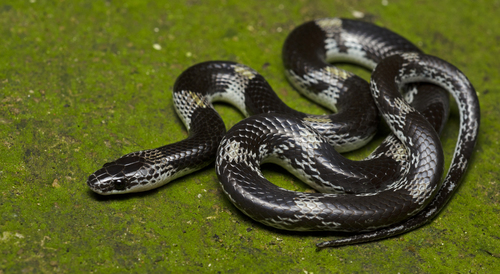
Barred Wolf Snake
Lycodon striatus
A secretive nocturnal hunter, the Barred Wolf Snake is a master of the night. With its striking white bands and glossy scales, this harmless reptile is a fascinating and beneficial visitor to South Asian gardens.
Quick Identification
Size
Typically 30–45 cm (12–18 inches) in length; maximum length rarely exceeds 60 cm (24 inches).
Colors
Glossy black or dark chocolate brown body with clear white or pale yellow transverse bars that are more prominent on the sides; belly is uniform white or cream.
Key Features
- Depressed, slightly flattened head broader than the neck
- Large eyes with vertical pupils
- 15 to 20 distinct white or yellow cross-bars
- Smooth, glossy dorsal scales in 17 rows
When You’ll See Them
Geographic range
Where Does the Barred Wolf Snake Live?
Native to Southern Asia and parts of the Middle East, the Barred Wolf Snake occupies a wide territory stretching from eastern Iran and Afghanistan through Pakistan, India, and Nepal, down into the island of Sri Lanka. Within this core range, it is a common sight in the dry-zone forests and rural landscapes of India and Pakistan, where it has successfully adapted to living in human-modified environments like parks and gardens.
Basemap © OpenStreetMap contributors
Behavior
The Barred Wolf Snake is a shy, strictly nocturnal reptile that spends most of its daylight hours tucked away in cool, dark crevices, under rock piles, or buried beneath leaf litter. While its name sounds formidable, this snake is non-venomous and generally docile, though it may vibrate its tail or strike if it feels cornered. It is a terrestrial species but is an expert at navigating the nooks and crannies of stone walls and garden foundations.
In suburban environments, these snakes are often found near human dwellings because they are attracted to the same things we are: shelter and food. They are frequently spotted near outdoor lights where their primary prey—small lizards—gather to hunt insects. Despite their resemblance to the highly venomous Common Krait, the Barred Wolf Snake is a harmless and beneficial predator that helps balance the local ecosystem by controlling lizard populations.
EverydayEarth exclusive
Camera Tips
To capture the Barred Wolf Snake on camera, focus your efforts on ground-level 'corridors' where reptiles travel. Aim your camera at the base of stone walls, along the edges of house foundations, or near piles of firewood and rocks. Because these snakes are small and move relatively slowly, place the camera no higher than 12–18 inches from the ground and angle it slightly downward to ensure the trigger sensor picks up their low-profile movement.
Since they are strictly nocturnal, a camera with high-quality infrared (no-glow) flash is essential to avoid startling the snake or other backyard wildlife. Look for activity near outdoor light sources; while the snake isn't attracted to the light itself, it will hunt the geckos that congregate there. Setting your camera to 'Video Mode' or 'Burst Photo Mode' is highly recommended, as a single still image may only capture a tail or a blurry mid-section.
The best time to see them is during the humid months of the monsoon season, as the rain brings out their prey and forces the snakes to move to higher ground. Increase your camera's PIR (motion sensor) sensitivity to 'High,' as the cold-blooded nature of the snake means it may not always trigger sensors designed for warm-blooded mammals. If you have a water feature or a damp garden patch, these are also excellent spots for placement.
Similar Species
Species that look similar or are commonly confused with Barred Wolf Snake.
Common Krait
The Krait has a row of enlarged hexagonal scales down its spine and its white bands usually appear in pairs, whereas the Wolf Snake has uniform dorsal scales.
Common Wolf Snake
The Common Wolf Snake (L. aulicus) usually has a more prominent white collar on the neck and lacks the distinct, neat barred pattern of L. striatus.
Frequently Asked Questions
Record Barred Wolf Snake at your habitat
Connect a camera to start building your own species record — AI identifies every visitor automatically.