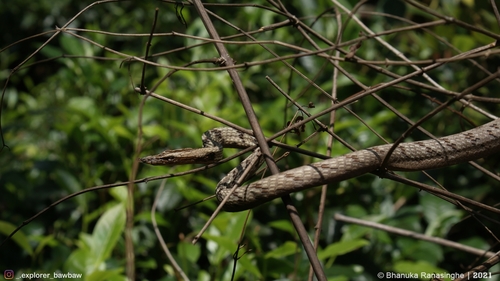
Brown-speckled Whipsnake
Ahaetulla pulverulenta
A master of disguise endemic to Sri Lanka, the Brown-speckled Whipsnake blends seamlessly into the brush. With its unique 'fleshy snout' and binocular vision, it is one of the most sophisticated arboreal predators in the backyard.
Quick Identification
Size
A very slender snake reaching 70–120 cm (28–47 inches) in length, with a body width often no thicker than a pencil.
Colors
Mottled brown, grey, or tan with fine dark brown or black speckling; the belly is usually paler with dark spots; features a distinct dark line passing through the eye.
Key Features
- Elongated, fleshy appendage on the tip of the snout
- Horizontal 'keyhole' pupils providing binocular vision
- Extremely slender, vine-like body profile
- Speckled brown camouflage mimicking dry twigs
When You’ll See Them
Geographic range
Where Does the Brown-speckled Whipsnake Live?
Native to the island of Asia, the Brown-speckled Whipsnake is a unique endemic species found only in Sri Lanka. It is widely distributed across the island's lowlands and reaches into the mid-hills, thriving in areas that offer dense foliage for concealment. While it is a specialist of the Sri Lankan ecosystem, it has adapted well to traditional home gardens and parks that maintain a vertical structure of trees and vines.
Basemap © OpenStreetMap contributors
Behavior
The Brown-speckled Whipsnake is a master of mimicry, spending the majority of its life draped over branches where it is nearly indistinguishable from a dry vine or twig. This species is diurnal, meaning it is most active during the daylight hours, relying on its exceptional eyesight to track prey. Unlike many other snakes, the genus Ahaetulla possesses binocular vision, allowing it to accurately judge distances when striking at fast-moving lizards.
When threatened, this snake employs a fascinating defensive display: it inflates its neck to reveal bright, contrasting scales hidden beneath the surface and opens its mouth wide to intimidate predators. While it is mildly venomous (rear-fanged), the toxin is specialized for small prey and is generally considered harmless to humans, typically causing only minor localized swelling if a rare bite occurs. In social terms, they are solitary hunters that prefer to stay high in the canopy or deep within thickets.
EverydayEarth exclusive
Camera Tips
Capturing the Brown-speckled Whipsnake on an AI-powered camera requires a specific focus on verticality. Since these snakes rarely descend to the ground, avoid placing your camera at the standard foot-high 'critter level.' Instead, mount your camera at chest height (about 1.2 to 1.5 meters) facing a known 'bridge' of vines or a dense shrubbery line where lizards—their primary food source—are frequently seen basking.
Because this species moves with a slow, swaying motion to mimic a twig in the wind, it can sometimes fail to trigger standard PIR (Passive Infrared) sensors. To combat this, use a camera with high sensitivity settings or, if your software allows, 'Time Lapse' mode with short intervals (every 1-2 minutes) during the peak morning hours when they are most likely to be moving to sun-drenched spots. Ensure the camera's focal distance is set for close-range if you are pointing it directly at a branch.
Direct sunlight can wash out the intricate speckled patterns that distinguish this species from other vine snakes. Position your camera so it is south-facing to avoid direct lens flare, and try to frame a background of dark green leaves; this contrast will help the brown and grey body of the snake pop in the final image. No artificial lures or baits are effective for this species, as they only respond to live, moving prey, so the best strategy is to locate 'lizard hotspots' in your garden.
Similar Species
Species that look similar or are commonly confused with Brown-speckled Whipsnake.
Frequently Asked Questions
Record Brown-speckled Whipsnake at your habitat
Connect a camera to start building your own species record — AI identifies every visitor automatically.