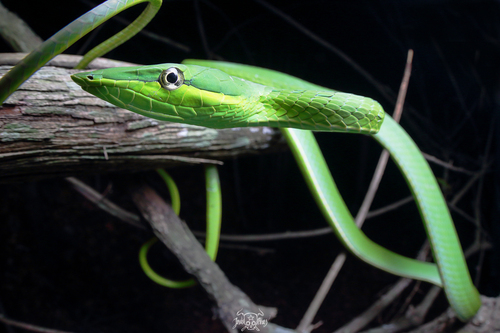
Green Vine Snake
Oxybelis fulgidus
A masterpiece of evolution, the Green Vine Snake is a slender, emerald-hued ghost of the canopy. Watching one navigate the treetops with its needle-thin body is one of nature’s most mesmerizing sights.
Quick Identification
Size
Extremely slender, reaching 1.5 to 2 meters (5 to 6.6 feet) in length, with a body width often no thicker than a human finger.
Colors
Brilliant emerald green across the back and sides, with a thin, pale yellow or white longitudinal stripe separating the green upper body from the lighter green belly.
Key Features
- Extraordinarily long, pointed snout
- Pencil-thin body adapted for arboreal life
- Large eyes with horizontal pupils for binocular vision
- Distinctive white or yellow line along the lower flanks
When You’ll See Them
Geographic range
Where Does the Green Vine Snake Live?
The Green Vine Snake is a signature species of the Neotropics, stretching its range from the lowlands of southern Mexico throughout the entirety of Central America. In South America, it occupies a vast territory that includes the Amazon Basin, reaching into Colombia, Venezuela, and as far south as Bolivia and central Brazil. Because it thrives in lush vegetation, it is frequently found in coastal regions and humid forest corridors across these continents.
Basemap © OpenStreetMap contributors
Behavior
The Green Vine Snake is a master of mimicry, spending the majority of its life draped across branches where it is nearly indistinguishable from the surrounding foliage. Unlike many other snakes, it is highly visual and uses its horizontal pupils to track movement with surprising precision. When it detects a breeze, it often sways its body back and forth, perfectly imitating a vine or a twig moving in the wind to remain hidden from both predators and prey.
While it is an 'opisthoglyphous' or rear-fanged species, it is generally not considered dangerous to humans. Its venom is mild and specifically evolved to immobilize small vertebrates like lizards. In a backyard or garden setting, it is a shy and non-aggressive resident, preferring to flee into the canopy rather than engage. However, if cornered, it may open its mouth wide to reveal a dark interior as a warning display.
EverydayEarth exclusive
Camera Tips
Capturing a Green Vine Snake on camera is a significant challenge due to their incredible camouflage and arboreal nature. Instead of pointing your camera at the ground, mount it 5 to 8 feet high on a tree trunk, angled to look along horizontal branches or across a gap between dense shrubs. These snakes use these 'aerial highways' to move between hunting grounds.
Because they move slowly and rhythmically, standard PIR (Passive Infrared) motion sensors can sometimes miss them. Set your camera to its highest sensitivity level and use a 'Time Lapse' mode if available, taking a photo every 5-10 minutes during the morning hours when they are most likely to be active and basking.
Focus your efforts on areas where lizard activity is high, such as garden trellises or flowering shrubs that attract insects (which in turn attract the lizards the snake eats). If you are using a trail camera with video capability, set a longer trigger duration (20-30 seconds) to capture their unique swaying movement, which is often the only way to distinguish them from a real vine on film.
Similar Species
Species that look similar or are commonly confused with Green Vine Snake.
Frequently Asked Questions
Record Green Vine Snake at your habitat
Connect a camera to start building your own species record — AI identifies every visitor automatically.