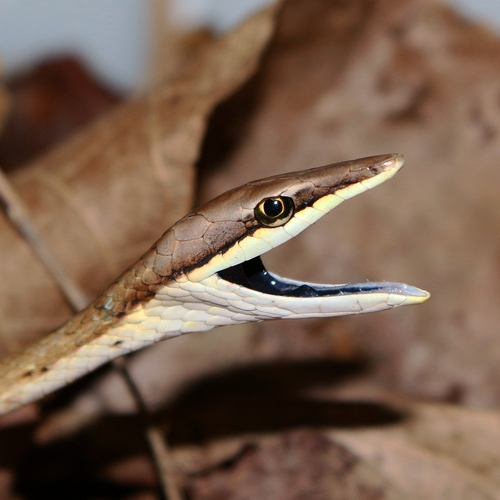
brown vine snake
Oxybelis aeneus
Meet the master of disguise. The brown vine snake is a slender, arboreal marvel that turns the act of 'hiding in plain sight' into a survival strategy across the Americas.
Quick Identification
Size
A remarkably slender snake reaching 1.5–1.9 meters (5–6 feet) in length, though rarely thicker than a human index finger.
Colors
Muted bronze, tan, or gray-brown dorsally with a pale cream or yellowish belly; a dark line often runs through the eye.
Key Features
- Extremely elongated, needle-like snout
- Vine-like body that sways to mimic branches
- Large, gold-colored eyes with round pupils
- Inside of the mouth is often black or bright yellow for defensive displays
When You’ll See Them
Geographic range
Where Does the brown vine snake Live?
Native to the Americas, the brown vine snake occupies a massive geographic footprint. Its northernmost limits reach into the rugged canyons of southern Arizona in the United States, extending south through the coastal and interior regions of Mexico. It is a common resident throughout Central America and continues deep into South America, where it is found across the Amazon basin as far south as northern Argentina and Brazil. It thrives in diverse environments, from arid scrublands to humid tropical rainforests.
Basemap © OpenStreetMap contributors
Behavior
The brown vine snake is a diurnal specialist in the art of crypsis. Unlike many snakes that flee at the first sign of trouble, this species relies on its incredible camouflage to remain undetected. It often spends hours perfectly still, coiled among branches, or sways rhythmically back and forth to mimic a twig blowing in the wind. This 'vine mimicry' is so effective that birds and lizards often perch right next to them without realizing the danger.
When hunting, the brown vine snake is a patient predator. It uses its keen eyesight to track the slightest movements of lizards and frogs. While it possesses a mild venom used to subdue its prey, it is rear-fanged and generally harmless to humans, typically preferring to gape its mouth open in a threatening 'bluff' rather than bite. They are almost entirely arboreal, rarely descending to the ground except to move between isolated patches of vegetation.
EverydayEarth exclusive
Camera Tips
Capturing a brown vine snake on camera requires a strategy focused on verticality and movement. Because these snakes are so thin and often remain motionless, standard PIR (Passive Infrared) sensors may struggle to detect them. Set your camera to its highest sensitivity and, if possible, use 'Time Lapse' mode alongside motion triggers to catch them as they slowly navigate through the canopy.
Position your camera 4 to 6 feet off the ground, aiming it along horizontal branches or fence lines that connect dense shrubs. These snakes often use 'wildlife highways' like garden trellis systems or low-hanging branches to move through suburban yards. Avoid pointing the camera directly into the sun, as the thin profile of the snake can easily be washed out by harsh backlighting; a shaded, leafy background provides the best contrast for their bronze scales.
Since they are diurnal hunters, focus your efforts on the morning and mid-afternoon hours. You can 'bait' an area indirectly by maintaining a bird bath or lizard-friendly rock pile, as the vine snake will naturally frequent areas where its prey congregates. Video mode is highly recommended over still photos, as the snake’s unique swaying motion is one of its most fascinating characteristics and makes identification much easier.
Similar Species
Species that look similar or are commonly confused with brown vine snake.
Frequently Asked Questions
Record brown vine snake at your habitat
Connect a camera to start building your own species record — AI identifies every visitor automatically.