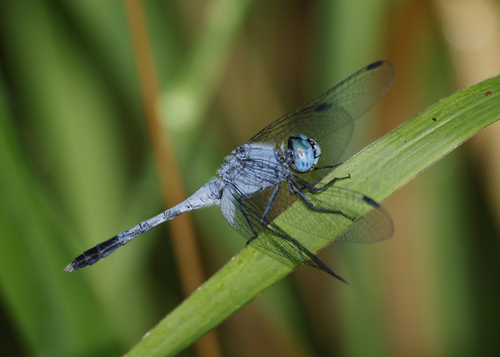
Chalky Percher
Diplacodes trivialis
A master of the garden path, the Chalky Percher is a distinctive blue dragonfly known for its unique habit of basking on the ground rather than the trees.
Quick Identification
Size
Length: 25-32 mm (1-1.25 inches); Wingspan: 40-52 mm (1.5-2 inches)
Colors
Mature males are a powdery blue-grey (pruinosed); females and immature males are yellow with black tiger-like markings.
Key Features
- Chalky blue-grey body in mature males
- Yellow and black patterned abdomen in females
- Clear wings with a very small pale spot at the base
- Frequent habit of perching on the ground or low rocks
When You’ll See Them
Geographic range
Where Does the Chalky Percher Live?
This resilient dragonfly is native to a vast stretch of the Old World, spanning from the islands of the Indian Ocean through Southeast Asia to Australia. It is frequently encountered across India, China, Japan, and the Maldives, and its range extends southward through the Philippines and New Guinea to the northern and eastern reaches of the Australian continent. In the west, its presence is felt in the arid landscapes of Oman and the United Arab Emirates, where it thrives near any available water source.
Basemap © OpenStreetMap contributors
Behavior
The Chalky Percher is one of the most adaptable and widespread dragonflies in the Eastern Hemisphere. Unlike many dragonflies that prefer high perches on twigs or reeds, this species is famously known for its 'ground-hugging' habit. It spends a significant portion of its day perching on bare soil, gravel paths, or sun-warmed rocks, which helps it regulate its body temperature.
These dragonflies are active hunters but are generally less aggressive and territorial than larger species. They exhibit a 'sit-and-wait' predatory style, darting out from their ground perch to snatch small flying insects mid-air before returning to the exact same spot. They are remarkably tolerant of human presence, often remaining perfectly still on a garden path even as someone walks past.
EverydayEarth exclusive
Camera Tips
Capturing the Chalky Percher on a backyard camera requires a specialized setup because they rarely use the high perches that other dragonflies favor. Instead of mounting your camera at eye level, place it extremely low—ideally just 2 to 5 inches off the ground. Aim the lens at a flat, sun-exposed surface like a concrete paving stone, a dark garden rock, or a patch of bare gravel. These surfaces act as heat sinks that attract the dragonflies for basking.
Because these insects are relatively small, standard PIR motion sensors on trail cameras may not always trigger. To compensate, use a camera with a 'Time Lapse' or 'Field Scan' mode. Set it to take a photo every 30 to 60 seconds during the peak heat of the day (10 AM to 3 PM). If your camera allows for it, use a high-sensitivity setting for the motion trigger to help catch the quick darting movements of the percher.
Lighting is key for highlighting the 'chalky' blue texture of the males. Position your camera so the sun is behind you or to the side; direct midday sun will reflect beautifully off the male's pruinosed body and the transparent veins of the wings. If you are using a DSLR-based AI camera, a macro lens with a wider aperture will help blur out the ground background and make the dragonfly pop. Ensure there is no swaying vegetation in the immediate foreground, as this will trigger the camera unnecessarily and drain the battery.
Similar Species
Species that look similar or are commonly confused with Chalky Percher.
Frequently Asked Questions
Record Chalky Percher at your habitat
Connect a camera to start building your own species record — AI identifies every visitor automatically.