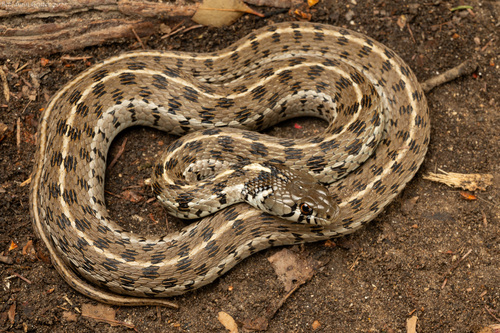
Checkered Garter Snake
Thamnophis marcianus
A master of desert survival with a striking geometric pattern, the Checkered Garter Snake is one of the most adaptable and common reptiles found in Southwestern backyards.
Quick Identification
Size
Total length 46-107 cm (18-42 inches); weight ranges from 70-200g
Colors
Olive, tan, or greenish-gray body with black checkered pattern; creamy yellow dorsal stripe and a distinct pale crescent behind the jaw
Key Features
- Bold black-and-tan checkered pattern along the body
- Distinctive pale crescent-shaped mark behind the mouth
- Yellowish dorsal stripe extending from head to tail
- Large, keeled scales giving the skin a rough texture
When You’ll See Them
Geographic range
Where Does the Checkered Garter Snake Live?
The Checkered Garter Snake is native to the Americas, with a primary range centered in the southwestern United States and Mexico. It is most commonly found across Texas, New Mexico, and Arizona, extending south through the Mexican highlands and into parts of Central America including Guatemala, Belize, and Honduras. These snakes are particularly successful in human-altered landscapes, often thriving in agricultural areas and suburban neighborhoods where water is consistently available.
Basemap © OpenStreetMap contributors
Behavior
Checkered Garter Snakes are active, alert reptiles that spend much of their time hunting near water or basking in the sun. While they are primarily diurnal, meaning they are active during the day, they frequently shift to a nocturnal schedule during the peak heat of summer. They are highly capable swimmers but are more terrestrial than many other garter snake species, often found foraging in tall grass or garden mulch far from open water.
When humans approach, these snakes usually prefer to slip away silently into the undergrowth. If they feel cornered, they may flatten their heads to appear larger or vibrate their tails against dry leaves to mimic a rattlesnake. They are non-venomous and generally docile, though they can release a foul-smelling musk from their cloaca if handled, which serves as a very effective chemical defense against predators.
EverydayEarth exclusive
Camera Tips
To capture high-quality footage of a Checkered Garter Snake, focus your camera on 'micro-corridors' in your yard. Look for edges where a patio meets a garden bed, or along the base of a rock wall. Position your camera extremely low—no more than 3 to 5 inches off the ground—and tilted slightly downward. Because these snakes are low-profile, a standard trail camera mounted on a fence post will often miss them entirely or only capture a blurry glimpse of their back.
Providing a 'stage' is the best way to get clear, still shots. Place a flat, dark-colored stone or a piece of driftwood in a spot that receives early morning sun. Snakes are cold-blooded and will seek out these thermal patches to warm up after a cool night. If you aim your camera at this basking spot, you are much more likely to trigger a recording of the snake resting in place rather than just zipping through the frame. Ensure there is no tall grass directly in front of the lens, as wind-blown vegetation will cause endless false triggers.
In hot, arid climates, water is the ultimate lure. A shallow saucer of water or a slow-dripping garden hose near a rock pile can act as a magnet for Checkered Garter Snakes. During the summer, they are most active during the 'golden hours' just after sunrise and just before sunset. Set your camera’s sensitivity to high and, if possible, use a 'photo burst' or 'high-frame-rate video' setting to catch their flicking tongues and quick movements. If your camera has a macro lens or a close-focus adjustment, use it; the fine details of their checkered scales are stunning when captured in high resolution.
Similar Species
Species that look similar or are commonly confused with Checkered Garter Snake.
Frequently Asked Questions
Record Checkered Garter Snake at your habitat
Connect a camera to start building your own species record — AI identifies every visitor automatically.