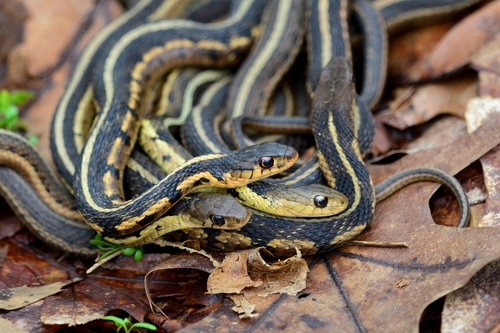
Common Garter Snake
Thamnophis sirtalis
The Common Garter Snake is North America's most familiar backyard reptile, recognizable by its racing stripes and gentle nature. A master of adaptation, it is as comfortable in a suburban flowerbed as it is in a wild mountain meadow.
Quick Identification
Size
Average length of 46–66 cm (18–26 in), reaching a maximum of 137 cm (54 in); typical weight is approximately 150 g (5.3 oz).
Colors
Variable background of black, brown, or olive-green with three distinctive yellow, white, or light green longitudinal stripes. Some individuals exhibit red or orange spotting between the stripes.
Key Features
- Three prominent longitudinal yellow or cream stripes
- Large, visible scales with a keeled (ridged) texture
- Head is slightly wider than the neck with large eyes and round pupils
- Labial (lip) scales are often barred with black
When You’ll See Them
Geographic range
Where Does the Common Garter Snake Live?
Native to the North American continent, the Common Garter Snake has one of the most expansive distributions of any reptile in the region. It is found throughout the United States and most of southern Canada, ranging from the Atlantic coast to the Pacific Northwest. This hardy species even extends its reach into parts of Northern Mexico, thriving in diverse environments from humid coastal plains to high mountain meadows.
Basemap © OpenStreetMap contributors
Behavior
The Common Garter Snake is one of the most social and adaptable reptiles in North America. Primarily diurnal, these snakes spend their mornings basking on rocks, logs, or pavement to absorb heat before beginning their hunt. They are well-known for their winter brumation, where hundreds or even thousands may gather in underground dens called hibernacula to survive freezing temperatures, emerging en masse in a spectacular display during early spring.
While they are generally shy and will flee into vegetation or water when approached, they have a few unique defense mechanisms. If caught, they may release a foul-smelling musk from their cloaca or flatten their bodies to appear larger. Despite being technically mildly venomous (their saliva is toxic to small amphibians and fish), they are harmless to humans and rarely bite unless significantly provoked.
EverydayEarth exclusive
Camera Tips
Capturing the Common Garter Snake on a backyard camera requires a 'ground-level' strategy. Mount your camera no more than 2 to 4 inches off the ground, aiming the lens along natural 'corridors' like the edge of a garden bed, a stone wall, or a fallen log. These snakes prefer to travel along edges where they feel protected while remaining close to basking spots. A horizontal angle is essential to capture the full length and distinctive striping of the snake.
Because snakes are ectothermic and lack the high body heat of mammals, standard PIR motion sensors can struggle to detect them. To solve this, set your camera to 'Time-Lapse' mode during the warmest hours of the day (10 AM to 3 PM) with an interval of 30 seconds to 1 minute. Alternatively, look for cameras with highly sensitive triggers or 'All-Motion' settings that detect pixel changes rather than just heat signatures.
To create a hotspot for filming, place a large, flat, dark-colored rock in a sun-drenched area and aim your camera there. This basking site will naturally attract snakes looking to warm up. You can also improve your chances by providing a small water feature or leaving a patch of tall, native grass nearby, which serves as a hunting ground for the earthworms and frogs that garter snakes love to eat. High-resolution video settings (1080p or higher) are recommended to capture the rapid flicking of the tongue, which is one of the most charismatic behaviors to see on film.
Similar Species
Species that look similar or are commonly confused with Common Garter Snake.
Western Ribbon Snake
Much more slender with a longer tail and a distinct white spot in front of each eye.
DeKay's Brownsnake
Smaller and lacks the long, bright longitudinal stripes, instead featuring a light brown stripe bordered by small black spots.
Plains Garter Snake
Has a more vivid orange dorsal stripe and black bars on the labial scales are much more pronounced.
Frequently Asked Questions
Record Common Garter Snake at your habitat
Connect a camera to start building your own species record — AI identifies every visitor automatically.