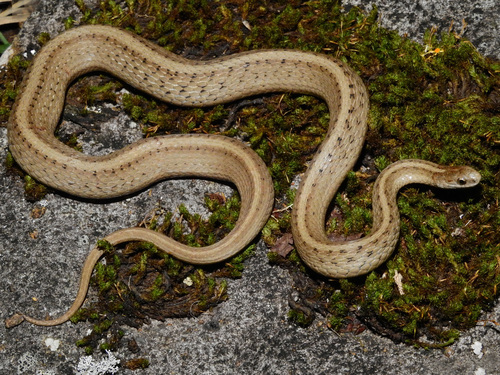
DeKay's Brownsnake
Storeria dekayi
Often mistaken for a baby snake, the DeKay's Brownsnake is a full-grown garden guardian that specializes in eating slugs. Harmless and helpful, this master of camouflage is likely the most common neighbor you've never actually seen.
Quick Identification
Size
23-33 cm (9-13 inches) in length; weight typically 5-15 grams
Colors
Light brown to grayish-brown body; light central dorsal stripe bordered by two rows of dark spots; dark markings on the sides of the head
Key Features
- Small and slender, typically under 13 inches
- Two rows of dark spots flanking a pale dorsal stripe
- Dark downward-pointing mark below each eye
- Keeled scales giving a rough texture
When You’ll See Them
Geographic range
Where Does the DeKay's Brownsnake Live?
Native to the North American continent, the DeKay's Brownsnake boasts a massive range extending from southern Canada through the eastern and central United States. Its territory continues south through Mexico and into parts of Central America, reaching as far as Honduras and Guatemala. Because they are highly adaptable to human-altered landscapes, they are often the most common snake found in densely populated metropolitan areas across their range, though they are frequently overlooked due to their size.
Basemap © OpenStreetMap contributors
Behavior
DeKay's Brownsnakes are incredibly shy and secretive creatures that spend most of their lives hidden beneath leaf litter, rocks, or garden debris. Despite their proximity to humans, they are rarely seen because they prefer to stay tucked away from predators. They are entirely harmless and lack the specialized teeth to bite humans, instead relying on their excellent camouflage to remain undetected in the soil and mulch.
When threatened, these snakes may flatten their bodies to appear larger or release a mild-smelling musk from their vent to deter predators. They are one of the most urban-adapted snake species in the world, frequently thriving in backyard gardens, vacant lots, and city parks. In these environments, they provide a valuable free pest control service by hunting garden slugs and snails.
EverydayEarth exclusive
Camera Tips
Capturing a DeKay's Brownsnake on camera requires a strategy focused on ground-level activity. Because these snakes are small and low-profile, you must position your camera as close to the earth as possible—ideally just 2 to 4 inches off the ground. Aim the lens toward 'edge habitats,' such as the border between a flower bed and a stone path, or near the base of a log pile. These are the natural highways these snakes use to move safely through your yard without being spotted by hawks.
Since these snakes are cold-blooded and move relatively slowly, standard PIR motion sensors might sometimes miss them. To increase your success rate, set your camera to its highest sensitivity level and use the shortest possible trigger interval. If your camera supports a 'Time Lapse' or 'Field Scan' mode, setting it to take a photo every 30 to 60 seconds during the morning and evening hours can capture sightings that the motion sensor might otherwise skip over.
For the best results, place your camera near a 'natural lure.' A flat piece of plywood, a large flat rock, or a piece of corrugated metal placed in a sunny spot near garden cover acts as a perfect basking site. Brownsnakes will often pause under or on top of these items to regulate their body temperature. Position your camera to overlook this area, particularly during the spring and autumn when the snakes are most active during the day. Keeping the area slightly moist with a drip line or occasional watering can also attract the slugs and worms that will, in turn, attract the Brownsnake to your camera's field of view.
Similar Species
Species that look similar or are commonly confused with DeKay's Brownsnake.
Common Garter Snake
Garter snakes have more prominent, bright yellow longitudinal stripes and lack the specific dark spots behind the eyes found on Brownsnakes.
Red-bellied Snake
Very similar in size, but the Red-bellied Snake has a bright orange or red underside and three light spots on the nape of the neck.
Frequently Asked Questions
Record DeKay's Brownsnake at your habitat
Connect a camera to start building your own species record — AI identifies every visitor automatically.