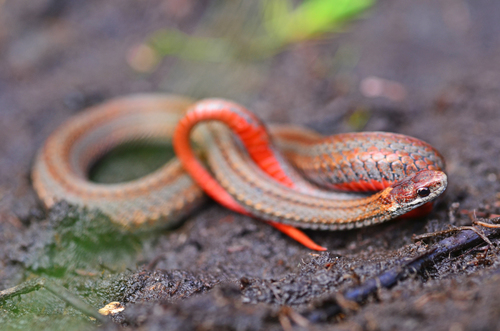
Red-bellied Snake
Storeria occipitomaculata
A hidden gem of the forest floor, the Red-bellied Snake is a master of camouflage with a fiery secret. This tiny, slug-eating specialist is a gardener's best friend and a fascinating subject for any backyard naturalist.
Quick Identification
Size
8-12 inches (20-30 cm) in length; rarely exceeds 16 inches (40 cm)
Colors
Brown, gray, or black dorsal side with a distinctly bright red, orange, or pink belly; three pale spots located just behind the head
Key Features
- Vibrant red or orange underside
- Three light-colored spots on the nape of the neck
- Keeled scales giving a rough texture
- Small, slender build with a narrow head
When You’ll See Them
Geographic range
Where Does the Red-bellied Snake Live?
The Red-bellied Snake is a native resident of North America, boasting an expansive range that covers nearly the entire eastern half of the continent. They are found from the Maritime Provinces of Canada and southern Quebec, extending southward through the United States to the Gulf Coast and as far west as the eastern Great Plains of the Dakotas, Nebraska, and Kansas. Within this territory, they are most abundant in humid, temperate regions where the forest floor remains moist throughout the summer months.
Basemap © OpenStreetMap contributors
Behavior
The Red-bellied Snake is an exceptionally secretive and docile species that spends much of its life hidden beneath the leaf litter, logs, or flat rocks of moist woodlands. Unlike many other snakes, they are almost never aggressive toward humans and rarely attempt to bite when handled. Instead, they may exhibit a unique 'lip-curling' behavior when threatened, showing their tiny teeth in a bluffing display known as Reuss's response.
These snakes are primarily solitary but can be found in high densities in favorable habitats. They are semi-fossorial, meaning they are well-adapted for burrowing into soft soil or navigating through the 'duff' layer of the forest floor. In suburban environments, they are often the 'invisible neighbors,' providing excellent pest control by hunting soft-bodied invertebrates in gardens and flower beds.
EverydayEarth exclusive
Camera Tips
Capturing a Red-bellied Snake on camera requires a specialized approach because of their small size and ground-hugging habits. To increase your chances, place your camera at ground level, ideally parallel to the earth. Because these snakes are only a few inches long, standard trail cameras may struggle with focus; look for a camera with a macro lens or a short focal distance (within 2-3 feet) to ensure the snake isn't just a blurry brown line in the frame.
One of the most effective methods for filming these snakes is the 'drift fence' technique. Place a long, flat board or a strip of landscape edging on its side to create a 4-10 foot barrier. Position your camera at one end of this barrier, aimed at the gap. As the snake crawls along the fence looking for a way around, it will be funneled directly in front of your lens. This is far more effective than hoping a snake randomly crosses a wide field of view.
Focus your efforts on damp, shaded areas near woodpiles, compost heaps, or large flat rocks. Red-bellied snakes are particularly active after a light rain when the humidity is high and their favorite prey—slugs—emerge to feed. In the spring and fall, they are often seen 'basking' on sun-warmed rocks or pavement to regulate their body temperature, which can provide excellent natural lighting for your shots.
For camera settings, use a high-sensitivity trigger if available, as these snakes move slowly and may not trigger sensors designed for larger mammals. A high-frame-rate video setting (60fps) is better than still photos, as it allows you to capture the subtle flicking of the tongue and the characteristic 'undulating' movement that makes reptile footage so compelling.
Similar Species
Species that look similar or are commonly confused with Red-bellied Snake.
Frequently Asked Questions
Record Red-bellied Snake at your habitat
Connect a camera to start building your own species record — AI identifies every visitor automatically.