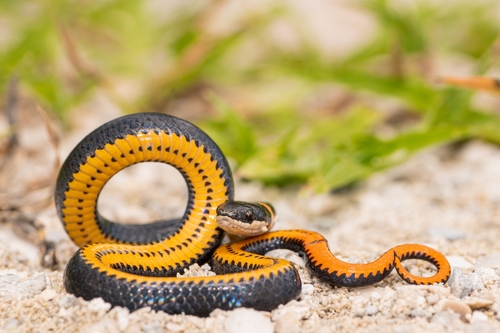
Ring-necked Snake
Diadophis punctatus
Small, secretive, and strikingly beautiful, the Ring-necked Snake is the hidden gem of North American backyards. Look for the flash of their namesake golden collar beneath stones and garden debris.
Quick Identification
Size
10 to 15 inches (25 to 38 cm) in length, rarely exceeding 18 inches (46 cm); very slender diameter.
Colors
Slate gray, bluish-black, or olive-brown back; bright yellow, orange, or red ring around the neck; matching bright underside often with small black spots.
Key Features
- Distinctive yellow or orange collar behind the head
- Brightly colored yellow to red belly
- Small, slender body with smooth scales
- Often curls its tail to show red underside when threatened
When You’ll See Them
Geographic range
Where Does the Ring-necked Snake Live?
The Ring-necked Snake is a native of North America, boasting one of the widest and most continuous distributions of any snake on the continent. Their core range stretches from southeastern Canada, including parts of Quebec and Ontario, through nearly the entire United States, reaching as far south as central Mexico. They are especially prevalent in the eastern half of the U.S. and along the Pacific coast, though they are found in localized pockets throughout the Great Plains and southwestern deserts.
Basemap © OpenStreetMap contributors
Behavior
Ring-necked Snakes are the masters of hide-and-seek in the reptile world. Primarily nocturnal and fossorial, they spend the vast majority of their lives tucked away under leaf litter, rotting logs, or flat stones. Because of their secretive nature, you could have a thriving population in your backyard and never see one during the day. They are socially tolerant and are often found in groups, particularly during the winter months when they may share communal dens or 'hibernacula' to stay warm.
When these snakes feel threatened, they employ a unique defense mechanism: they coil their tails into a tight corkscrew, flipping it over to reveal the bright red or orange underside to startle predators. While they are technically mildly venomous to their small prey using rear fangs, they are completely harmless to humans. Their tiny mouths are not designed for defense against large animals, and they almost never attempt to bite when handled, relying instead on their musk and bright warning colors.
EverydayEarth exclusive
Camera Tips
Capturing a Ring-necked Snake on camera requires a different strategy than larger wildlife because they rarely move across open ground. Instead of aiming your camera at a trail, focus on 'micro-habitats.' Place your camera near the ground looking at the edge of a large flat rock, a decaying log, or a moist pile of leaves. Since they are very small, use a camera with a short minimum focal distance or a dedicated macro lens if possible; otherwise, they may appear as a blurry gray line.
Because they are nocturnal, ensure your camera has a high-quality infrared (IR) flash that won't overexpose subjects at close range. Set your trigger sensitivity to the highest level, as these snakes are lightweight and may not trip standard PIR sensors. A great trick is to place a 'cover object' like a piece of untreated plywood or a large flat stone in a damp, shady part of your yard for a week, then set the camera to time-lapse mode (one frame every 1-5 minutes) nearby during a warm, humid evening.
Timing is everything for this species. They are most active on the surface after a heavy rain when the humidity is high and their prey, like earthworms and slugs, are also active. In the spring and fall, you are more likely to catch them moving between seasonal habitats. For the best results, position the camera just 2-3 inches off the ground, angled slightly downward to capture the distinctive neck ring as they weave through the grass.
Similar Species
Species that look similar or are commonly confused with Ring-necked Snake.
Frequently Asked Questions
Record Ring-necked Snake at your habitat
Connect a camera to start building your own species record — AI identifies every visitor automatically.