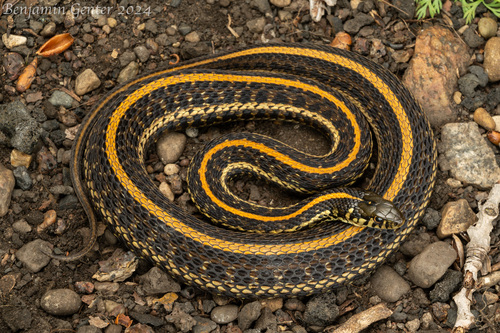
Plains Garter Snake
Thamnophis radix
Featuring a signature 'racing stripe' and an appetite for garden pests, the Plains Garter Snake is a hardy survivor found from the Canadian prairies to the Texas plains.
Quick Identification
Size
Adults typically range from 40 to 110 cm (16 to 43 inches) in total length, with females generally growing larger than males.
Colors
Olive-green, brown, or gray body with a vivid orange or yellow stripe down the center of the back. Two additional pale yellow stripes run along the sides, and the 'lips' feature distinctive black vertical bars.
Key Features
- Bright orange or yellow dorsal stripe running from head to tail
- Black vertical bars on the labial (lip) scales
- Lateral stripes located on the 3rd and 4th scale rows
- Checkered pattern of black spots between the stripes
When You’ll See Them
Geographic range
Where Does the Plains Garter Snake Live?
Native to the vast central heartland of North America, the Plains Garter Snake occupies a wide corridor stretching from the Canadian provinces of Alberta, Saskatchewan, and Manitoba southward through the Great Plains of the United States. Its range extends as far south as Texas and New Mexico, covering nearly the entire Midwest. While they are a staple of the American prairie, they are equally at home in fragmented urban landscapes and agricultural zones where water is accessible.
Basemap © OpenStreetMap contributors
Behavior
The Plains Garter Snake is a resilient and highly active diurnal reptile, often recognized as one of the most cold-tolerant snake species in North America. They are frequently the first snakes to emerge from winter dormancy, sometimes seen basking on sun-warmed rocks while snow still lingers nearby. While primarily solitary during their active months, they are famous for communal brumation, where hundreds may gather in underground 'hibernacula' such as old wells, mammal burrows, or rock crevices to survive the winter.
In the backyard, these snakes are docile and generally prefer to flee rather than fight. If they feel threatened and cannot escape, they may flatten their bodies to appear larger or release a pungent musk from their cloaca to deter predators. Despite possessing a very mild venom used to subdue small amphibians and earthworms, they are completely harmless to humans and pets, serving as an excellent natural form of pest control for gardens.
EverydayEarth exclusive
Camera Tips
To capture high-quality footage of a Plains Garter Snake, camera placement is everything. Since these snakes are low-profile and 'cold-blooded,' traditional PIR (Passive Infrared) sensors on trail cameras can struggle to detect them. Position your camera as close to the ground as possible—ideally just 2 to 5 inches high—and angle it slightly downward. Focus on 'bottleneck' areas like the edge of a garden pond, a gap under a fence, or a flat rock that receives direct morning sunlight, as these are prime basking spots.
Using a camera with a 'Time Lapse' mode or a high-sensitivity trigger setting is often more effective than standard motion detection for reptiles. If your camera allows, set the interval to take a photo every 30 seconds during peak morning hours (8 AM to 11 AM) when the snakes are moving to find sun. Look for 'corridors' where the lawn meets taller vegetation; snakes use these edges to travel while remaining hidden from hawks and other predators.
You can encourage 'striking a pose' for the camera by placing a large, flat, dark-colored stone or a piece of old plywood in a sunny area of your yard. These 'cover objects' absorb heat and provide a safe place for the snake to warm up. If you place your camera facing one of these spots, you are almost guaranteed to capture them as they emerge to bask or hide underneath. Avoid using chemical baits; instead, maintain a healthy, chemical-free garden that attracts earthworms and toads, which are the snake's natural food source.
Similar Species
Species that look similar or are commonly confused with Plains Garter Snake.
Frequently Asked Questions
Record Plains Garter Snake at your habitat
Connect a camera to start building your own species record — AI identifies every visitor automatically.