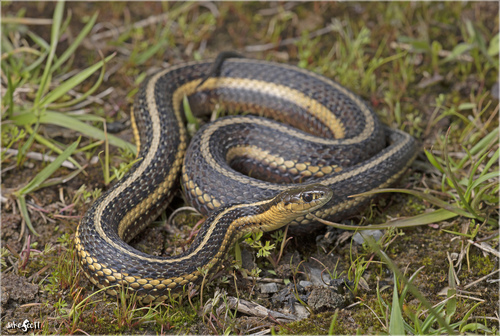
Butler's Garter Snake
Thamnophis butleri
A shy, slender specialist of the Great Lakes meadows, Butler's garter snake is a master of the tall grass. Known for its docile nature and striking yellow stripes, it is a rewarding find for any backyard wildlife enthusiast.
Quick Identification
Size
38 to 51 cm (15 to 20 inches) in length; typically weighs 15 to 50 grams
Colors
Dark brown, olive, or black background with three vivid yellow or orange-yellow stripes running the length of the body
Key Features
- Small, narrow head that is barely wider than the neck
- Yellow lateral stripes centered on the 3rd scale row, overlapping onto rows 2 and 4
- Distinctive 'thrashing' or sidewinding movement when startled
- Relatively short tail compared to other garter snakes
When You’ll See Them
Geographic range
Where Does the Butler's Garter Snake Live?
Native to the North American Great Lakes region, Butler's garter snake has one of the most restricted geographic ranges of any snake on the continent. Its core populations are primarily located in southeastern Michigan, northwestern Ohio, and northeastern Indiana, with significant isolated pockets found in southeastern Wisconsin and southwestern Ontario, Canada. This species is a true regional specialist, thriving in the moist, post-glacial landscapes of the Midwest.
Basemap © OpenStreetMap contributors
Behavior
Butler's garter snakes are significantly more shy and docile than their larger relatives. Unlike the common garter snake, which may strike if cornered, this species is much more likely to attempt a quick, erratic escape. They exhibit a unique 'sidewinding' motion on smooth surfaces where they thrash their bodies back and forth with great vigor but make very little forward progress, a trait that often helps naturalists identify them at a glance.
These snakes are highly localized and have very small home ranges, often spending their entire lives within a single acre of suitable habitat. They are somewhat social and can be found overwintering communally in underground burrows or crayfish holes. While they are primarily active during the day, they spend a large portion of their time hidden under logs, rocks, or thick thatch to avoid predators like hawks and crows.
EverydayEarth exclusive
Camera Tips
To successfully capture a Butler's garter snake on camera, you must focus on ground-level placement. These snakes are small and rarely climb, so mount your camera no higher than 4 to 6 inches off the ground. A 'drift fence' setup is the most effective method: place a long piece of wood or garden edging in a grassy area and point your camera at the midpoint. The snake will naturally travel along the edge of the barrier, leading it directly into your frame.
Because snakes are ectothermic, standard motion sensors (PIR) may not always trigger. To solve this, place a dark, flat 'basking rock' or a piece of slate within the camera’s view in a spot that receives direct morning sun. The snake will use the rock to warm up, providing you with a stationary subject and a much longer window for the camera to trigger. Setting your camera to 'Time Lapse' mode at 1-minute intervals during the morning hours (9 AM to 11 AM) is a great backup strategy if the motion sensor fails to pick them up.
Environmental timing is everything for this species. Aim to have your cameras active on humid mornings following a light rain, as this is when their primary prey—earthworms—are most active on the surface. Focus your efforts in 'transitional zones,' such as the border between a manicured lawn and a taller meadow or garden bed. Avoid using scents or lures, as these snakes are visual and tactile hunters; instead, ensure there is plenty of leaf litter or tall grass nearby to make them feel secure enough to emerge from hiding.
Similar Species
Species that look similar or are commonly confused with Butler's Garter Snake.
Frequently Asked Questions
Record Butler's Garter Snake at your habitat
Connect a camera to start building your own species record — AI identifies every visitor automatically.