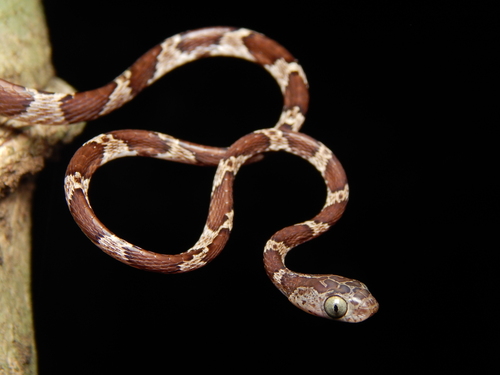
Common Blunt-headed Tree Snake
Imantodes cenchoa
Meet the ultimate acrobat of the night. With its oversized eyes and incredibly slender 'fiddle-string' body, the Common Blunt-headed Tree Snake is a master of the canopy, gracefully navigating the thinnest branches of the American tropics.
Quick Identification
Size
80–100 cm (31–39 inches) in length; extremely slender, often no thicker than a pencil.
Colors
Light brown or tan base with dark brown saddle-shaped blotches; pale belly with fine dark peppering.
Key Features
- Large bulging eyes with vertical pupils
- Extremely slender 'fiddle-string' body
- Distinctly blunt, rounded snout
- Large head set on a very thin neck
When You’ll See Them
Geographic range
Where Does the Common Blunt-headed Tree Snake Live?
Native to the Neotropics, this snake enjoys a vast distribution stretching from southern Mexico through Central America and deep into South America, including the Amazon Basin and as far south as northern Argentina. It is a common sight in the lowland rainforests and premontane forests of countries like Costa Rica, Panama, and Brazil, flourishing in humid environments where arboreal lizards are plentiful. Unlike many specialized reptiles, its adaptability has allowed it to maintain a stable presence across nearly the entire tropical belt of the Americas.
Basemap © OpenStreetMap contributors
Behavior
The Common Blunt-headed Tree Snake is a master of the arboreal world, spending nearly its entire life in the canopy or shrub layer. It is famous for its 'fiddle-string' physique, which allows it to bridge wide gaps between branches by extending more than half its body length into open air without support. This remarkable core strength is essential for navigating the complex three-dimensional environment of the rainforest at night.
While they possess a mild venom used to subdue small prey, they are generally shy and non-aggressive toward humans. Their primary defense is camouflage; when threatened, they may remain perfectly still, relying on their blotched pattern to blend into the shadows and lichen-covered branches. Because they are rear-fanged and have very small mouths, they pose no significant medical threat to people or pets.
EverydayEarth exclusive
Camera Tips
Capturing the Common Blunt-headed Tree Snake requires an elevated camera strategy. Since these snakes are strictly arboreal, mounting your camera at eye level or higher—between 5 and 10 feet up a tree trunk or overlooking a dense thicket of vines—is essential. Angle the lens slightly downward to capture them as they glide across branches. Because they are so incredibly thin and cold-blooded, PIR sensors can struggle to detect them; use a high-sensitivity motion trigger or a short-interval time-lapse mode to ensure you don't miss their slow, deliberate movements.
Since this species is exclusively nocturnal, your camera's infrared (IR) performance is the most critical factor. Look for 'no-glow' or 'black' IR LEDs to avoid startling the snake or its prey, which could lead to the snake leaving the frame quickly. Ensure your camera is positioned near 'high-traffic' zones like flowering shrubs or broad-leafed plants (like Heliconias or Bromeliads) where anoles and tree frogs—the snake's primary food source—tend to sleep at night.
Baiting isn't usually effective for these snakes as they are active hunters of live prey, but you can 'bait' the area by attracting their food. A small outdoor light nearby that attracts nocturnal insects will, in turn, attract the frogs and lizards that the Common Blunt-headed Tree Snake hunts. Position your camera to face a horizontal branch or a vine that serves as a natural 'highway' through the vegetation, as these snakes prefer clear paths for movement through the canopy.
Similar Species
Species that look similar or are commonly confused with Common Blunt-headed Tree Snake.
Frequently Asked Questions
Record Common Blunt-headed Tree Snake at your habitat
Connect a camera to start building your own species record — AI identifies every visitor automatically.