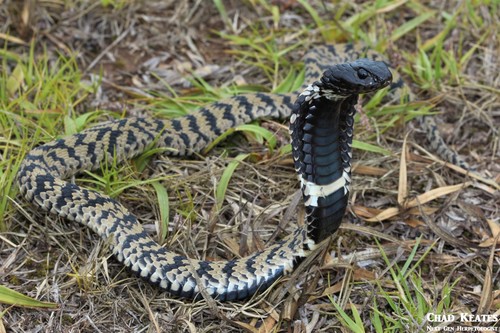
common rinkhals
Hemachatus haemachatus
Not a 'true' cobra but every bit as dramatic, the Rinkhals is famous for its striking white throat bands and its ability to play dead. A resident of Southern Africa's grasslands, it is a fascinating neighbor for those with AI-powered backyard cameras.
Quick Identification
Size
Average length of 90–110 cm (35–43 inches), with rare specimens reaching 1.5 m (59 inches).
Colors
Dorsally dark brown, black, or grey, often with lighter cream or yellowish crossbands. The belly is dark with 1–3 conspicuous white bands across the throat.
Key Features
- Distinctive white or cream crossbands on the throat
- Rough, keeled (ridged) body scales unlike the smooth scales of true cobras
- Broad, dramatic hood when threatened
- Unique behavior of 'shamming death' by rolling onto its back
When You’ll See Them
Geographic range
Where Does the common rinkhals Live?
The Common Rinkhals is an iconic resident of the southern African subcontinent. It is natively distributed across a wide swath of South Africa, particularly in the eastern and southern provinces such as the Western Cape, Eastern Cape, KwaZulu-Natal, and the Highveld of Gauteng. Its range also extends into the mountainous regions of Lesotho and across Eswatini. While it was historically associated with Zimbabwe, those populations are now classified as a distinct species, making the Common Rinkhals a true specialist of the temperate and subtropical south.
Basemap © OpenStreetMap contributors
Behavior
The Rinkhals is a master of defensive theater. While it belongs to the elapid family and can spread a broad hood to mimic a true cobra, it has a unique secondary defense mechanism: thanatosis, or 'playing dead.' If its hooding and spitting fail to ward off a predator, the Rinkhals will roll onto its back, go limp, and leave its mouth hanging open, appearing completely lifeless until the threat passes.
Unlike many other venomous snakes that lay eggs, the Rinkhals is ovoviviparous, meaning it gives birth to fully formed live young, often in litters of 20 to 30. They are primarily diurnal, spending their mornings basking in the sun to regulate their body temperature, though they may become more active at night during the peak of summer to hunt for amphibians.
EverydayEarth exclusive
Camera Tips
To capture the elusive Rinkhals on a backyard or trail camera, placement is everything. These snakes are low-profile and spend much of their time moving through tall grass or along the edges of garden rockeries. Position your camera just 2 to 4 inches off the ground. If your camera allows for an upward tilt, aim it slightly toward a flat 'basking rock' where the snake might stop to warm itself in the morning sun.
Because the Rinkhals is a specialist hunter of amphibians, the best 'bait' isn't food for the snake, but habitat for its prey. Placing your camera near a garden pond, a leaky outdoor tap, or a consistently damp area will significantly increase your chances of a sighting, as these spots attract the toads that Rinkhals seek. Use high-sensitivity PIR settings, as reptiles are cold-blooded and may not always trigger heat-based sensors as effectively as mammals; cameras with 'motion-only' or time-lapse modes can help fill this gap.
Focus your monitoring during the Southern Hemisphere's spring and summer (September to April). During this window, mid-morning is the prime time for basking activity. Set your camera to record short video clips rather than just still photos. The most compelling footage of a Rinkhals often involves its defensive hooding or its peculiar 'death-feigning' behavior, which can only be truly appreciated in motion. Ensure you use a camera with a fast trigger speed to catch their quick strikes or spitting actions.
Similar Species
Species that look similar or are commonly confused with common rinkhals.
Frequently Asked Questions
Record common rinkhals at your habitat
Connect a camera to start building your own species record — AI identifies every visitor automatically.