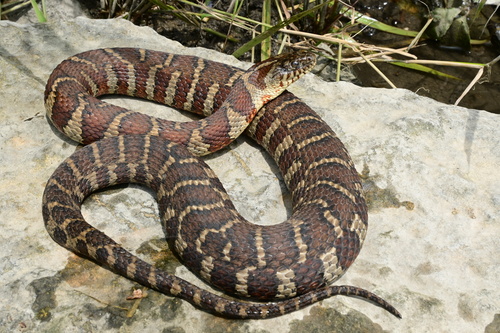
Common Watersnake
Nerodia sipedon
The Common Watersnake is North America's most frequent aquatic visitor, often seen sunning itself on riverbanks or gliding through backyard ponds. While they are famous for their feisty temperament, these nonvenomous hunters are a vital sign of a healthy wetland ecosystem.
Quick Identification
Size
Length of 61-122 cm (24-48 inches); weight typically 100-500g, with large females being significantly heavier
Colors
Brown, gray, or tan base with dark brown to reddish-black crossbands near the head that transition into alternating blotches down the body
Key Features
- Keeled scales giving a rough texture
- Dark vertical lines or 'stitching' on the labial (lip) scales
- Round pupils and a head only slightly wider than the neck
- Belly scales marked with reddish-brown half-moon crescents
When You’ll See Them
Geographic range
Where Does the Common Watersnake Live?
The Common Watersnake is native to the North American continent, found extensively throughout the Eastern and Central regions. Its range extends from southern Ontario and Quebec in Canada down through the United States to the Gulf Coast, reaching as far west as the Rocky Mountain foothills. This species is particularly prevalent across the Midwest and the Mid-Atlantic states, where it thrives in almost any permanent freshwater source.
Basemap © OpenStreetMap contributors
Behavior
Common Watersnakes are highly active, semi-aquatic reptiles known for their proficiency in the water. They are frequently observed basking on logs, flat rocks, or overhanging vegetation during the day to regulate their body temperature. While they are nonvenomous and generally prefer to flee when approached, they are notably defensive if cornered, often flattening their bodies to appear larger and striking repeatedly if handled.
These snakes are solitary for much of the year, though they may congregate in the spring for mating or during the winter months in communal underground dens called hibernacula. In suburban environments, they are remarkably adaptable and often become habituated to the presence of docks, dams, and backyard ponds, where they serve as an important control for local amphibian and fish populations.
EverydayEarth exclusive
Camera Tips
To capture the best footage of a Common Watersnake, position your AI-powered camera near high-traffic 'basking stations.' These are typically flat rocks or sun-exposed logs that sit half-submerged in the water. Because these snakes are cold-blooded, they must spend several hours a day in these specific spots during the morning and early afternoon. Aim your camera at a low angle, roughly 4-6 inches off the ground, to capture the intricate details of their keeled scales and facial markings.
If you have a backyard pond, the best placement is at the water's edge where the shoreline meets the vegetation. Common Watersnakes often 'cruise' these edges looking for frogs. You don't need artificial bait; instead, focus on creating a healthy ecosystem. If your pond has a steady population of croaking bullfrogs, the snakes will eventually show up to hunt. Set your camera's trigger sensitivity to high, as the smooth, gliding motion of a swimming snake can sometimes fail to trip less sensitive sensors.
Lighting is a major factor for reptile photography. During the peak of summer, these snakes may switch to nocturnal hunting to avoid extreme heat. Ensure your camera has a high-quality infrared night vision mode to catch them as they forage in the shallows after dark. Using a high frame rate (at least 30fps, but 60fps is better) will help you analyze their rapid striking motion when they catch prey, which is one of the most exciting behaviors to document on a trail camera.
Similar Species
Species that look similar or are commonly confused with Common Watersnake.
Frequently Asked Questions
Record Common Watersnake at your habitat
Connect a camera to start building your own species record — AI identifies every visitor automatically.