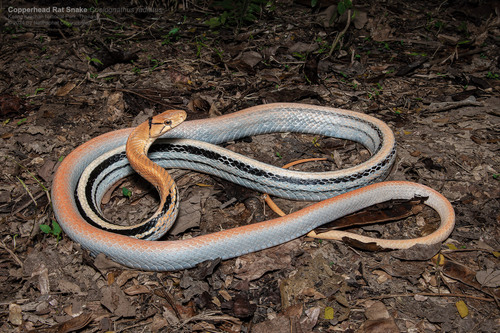
Copperhead Rat Snake
Coelognathus radiatus
Meet Asia's most dramatic nonvenomous serpent, a master of mimicry with a signature copper crown. Famous for its theatrical 'cobra-style' defensive pose and its role as a master rodent hunter, this snake is a vital part of the backyard ecosystem.
Quick Identification
Size
150 to 210 cm (4.9 to 6.9 feet) in total length; weight typically ranges from 500 to 1,500 grams (1.1 to 3.3 lbs).
Colors
Tan, pale brown, or yellowish-gray body; four distinct black longitudinal stripes on the anterior half; copper or bronze-colored head with black lines radiating from the eyes.
Key Features
- Copper-colored head with three black lines radiating from the eye
- Four black stripes on the front third of the body
- Slender, athletic build with a long tail
- Vertical neck inflation and S-shaped strike pose when threatened
When You’ll See Them
Geographic range
Where Does the Copperhead Rat Snake Live?
Native to the vast landscapes of South and Southeast Asia, the Copperhead Rat Snake thrives across a diverse geographic expanse. Its core range extends from the foothills of the Himalayas in India and Nepal through the tropical regions of Thailand, Vietnam, and Southern China, reaching as far south as the Indonesian archipelago and Malaysia. Because of its adaptability to human-altered landscapes, it is a common sight in both lowland plains and mid-elevation hill stations throughout the Oriental region.
Basemap © OpenStreetMap contributors
Behavior
The Copperhead Rat Snake is a highly active and remarkably bold colubrid known for its theatrical defensive displays. When it feels threatened, it doesn't just slink away; it compresses its neck vertically (rather than horizontally like a cobra) to appear larger and assumes a dramatic S-shaped striking posture. If this intimidation fails, the snake is one of several species known to feign death—flipping onto its back and remaining motionless to discourage predators.
Despite its aggressive posturing, this snake is nonvenomous and generally avoids human contact unless cornered. It is a diurnal hunter, meaning it is most active during the day, using its keen eyesight and speed to track down prey. In suburban environments, they are often tolerated or even welcomed by locals because they are highly efficient at controlling rodent populations around homes and granaries.
EverydayEarth exclusive
Camera Tips
To capture high-quality footage of a Copperhead Rat Snake, place your AI camera near 'linear features' in your yard, such as the edge of a garden wall, a fence line, or the foundation of a shed. Snakes are cautious and prefer to travel along edges where they have quick access to cover. Setting the camera at a low height—no more than 5 to 10 inches off the ground—is essential for capturing their distinctive copper head and dorsal stripes.
While you shouldn't use food bait for snakes, you can attract them indirectly by creating a 'reptile station' with a flat basking rock or a shallow water dish. Position your camera to face a sunny patch that receives early morning light, as these snakes often bask to regulate their temperature before hunting. Because they are fast-moving, ensure your camera is set to a high-sensitivity trigger with a short cool-down period to catch them as they glide through the frame.
Pay attention to the seasons; in many parts of Asia, these snakes are most visible just after the first heavy rains of the monsoon, which flushes out prey and encourages mating activity. If your camera supports video, use a high frame rate (60fps) to capture their unique defensive display if a curious pet or larger animal triggers a confrontation—this behavior is one of the most visually stunning sights in the reptile world.
Similar Species
Species that look similar or are commonly confused with Copperhead Rat Snake.
Frequently Asked Questions
Record Copperhead Rat Snake at your habitat
Connect a camera to start building your own species record — AI identifies every visitor automatically.