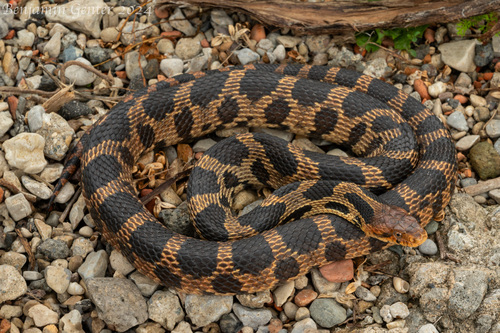
Eastern Foxsnake
Pantherophis vulpinus
A harmless and handsome helper in the garden, the Eastern Foxsnake is the Great Lakes' premier rodent hunter, easily recognized by its copper-colored head and bold, checkered patterns.
Quick Identification
Size
3 to 5 feet (91 to 152 cm) in length; rarely exceeding 6 feet (183 cm)
Colors
Yellowish to light brown ground color with large, dark brown or black rectangular blotches; head is often a distinct copper or reddish-orange color
Key Features
- Reddish-orange head without facial pits
- Large dark rectangular blotches along the back
- Yellowish belly with black checkered pattern
- Tail vibrates when threatened
When You’ll See Them
Geographic range
Where Does the Eastern Foxsnake Live?
Native to the North American Great Lakes region, the Eastern Foxsnake is primarily concentrated in the Upper Midwest of the United States and parts of southern Ontario, Canada. Its core range encompasses states like Michigan, Wisconsin, Illinois, Iowa, and Minnesota, where it thrives in the transition zones between wetlands and agricultural fields.
Basemap © OpenStreetMap contributors
Behavior
The Eastern Foxsnake is a powerful constrictor that spends much of its time on the ground, though it is a surprisingly capable climber and swimmer. Often mistaken for more dangerous species, it possesses a unique defense mechanism: when threatened, it rapidly vibrates its tail against dry leaves or grass, creating a buzzing sound that mimics a rattlesnake. Despite this bluff, they are generally docile and will usually attempt to retreat rather than strike.
These snakes are primarily active during the day, especially in the mild temperatures of spring and autumn. During the height of summer, they may shift to a crepuscular schedule, becoming more active at dawn and dusk to avoid the midday heat. While they are solitary hunters, they are often found near human structures like barns and old sheds where their primary prey is abundant. They hibernate underground during the winter, often in communal dens called hibernacula.
EverydayEarth exclusive
Camera Tips
To capture an Eastern Foxsnake on camera, you need to think low. Position your camera just 6 to 12 inches off the ground. These snakes are creatures of habit and often use 'wildlife highways' such as the edges of stone walls, fallen logs, or the perimeter of a garden fence. Angling the camera along these linear features increases your chances of a side-profile shot as they cruise for prey.
Sun-drenched spots are ideal locations for camera placement during the spring and fall. Look for flat rocks or pieces of old plywood in your yard; foxsnakes love to bask in these areas to regulate their body temperature. Setting your camera to a time-lapse mode or a high-sensitivity PIR (passive infrared) setting is crucial, as snakes are cold-blooded and may not always trigger standard motion sensors unless they are significantly warmer than the surrounding ground.
Don't bother with traditional food baits, as these snakes hunt live prey. Instead, create a 'natural lure' by maintaining a brush pile or a rock garden nearby, which attracts the rodents they feed on. Early morning (between 9 AM and 11 AM) is the 'golden hour' for foxsnake activity, as they emerge from their overnight shelters to warm up. In the peak of summer, switch your focus to the cooler evening hours just before sunset.
Similar Species
Species that look similar or are commonly confused with Eastern Foxsnake.
Frequently Asked Questions
Record Eastern Foxsnake at your habitat
Connect a camera to start building your own species record — AI identifies every visitor automatically.