Western Foxsnake
Pantherophis ramspotti
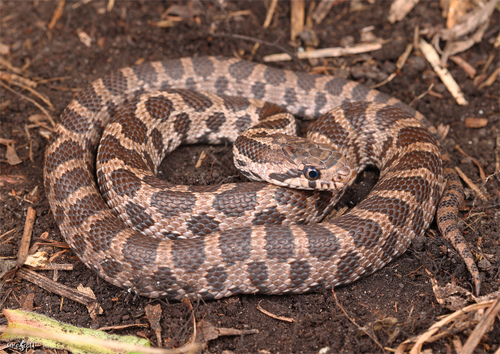
A harmless, hard-working rodent hunter of the American Midwest, the Western Foxsnake is easily recognized by its vibrant copper head and bold, checkered patterns.
Quick Identification
Size
36-60 inches (91-152 cm) in length; adults typically weigh between 0.9 and 2 lbs (400-900 g).
Colors
Light brown to yellowish-tan base with large, dark brown or black square-shaped blotches; head is often a solid rusty-orange or copper color.
Key Features
- Distinctive copper-colored head without a dark mask
- Large dark brown square blotches on a tan background
- Checkered black and yellow belly
- Smooth to weakly keeled scales and a pointed tail
When You’ll See Them
Geographic range
Where Does the Western Foxsnake Live?
Native to the North American continent, the Western Foxsnake is a quintessential resident of the Upper Midwestern United States. Its core range is situated west of the Mississippi River, flourishing throughout Iowa and Missouri, and extending north into Minnesota and South Dakota, as well as eastern Nebraska and Kansas. Within this region, they are highly adapted to the fertile agricultural landscapes and remaining tallgrass prairie fragments of the Great Plains.
Basemap © OpenStreetMap contributors
Behavior
The Western Foxsnake is a bold yet non-aggressive member of the rat snake family. They are primarily ground-dwellers, but they are surprisingly agile climbers and strong swimmers. When encountered by humans, they are generally docile, though they have a famous defense mechanism: they vibrate their tails rapidly in dry leaves or grass, creating a buzzing sound that mimics a rattlesnake to ward off predators. This behavior, combined with their copper-colored heads, often leads to them being misidentified as venomous species.
These snakes are active hunters that rely on constriction to subdue their prey. In the wild, they are solitary animals, though they may share communal dens during the winter hibernation months. They are known to emit a pungent, musky odor when handled—a scent that some say resembles that of a red fox, which gives them their common name.
EverydayEarth exclusive
Camera Tips
To capture high-quality footage of a Western Foxsnake, placement is everything. These snakes are "edge" specialists, meaning they love to travel along the boundaries where two habitats meet. Set your camera low to the ground—no more than 6-12 inches high—along the edge of a garden fence, a stone retaining wall, or a woodpile. Angling the camera slightly downward ensures that the snake's dorsal patterns are clearly visible for the AI to identify.
Because snakes are cold-blooded, traditional Passive Infrared (PIR) sensors can sometimes fail to trigger because the snake's body temperature matches the environment. For the best results, use a camera with a high-sensitivity PIR setting or, better yet, enable 'Time-Lapse' mode with a 30-second or 1-minute interval during the morning and late afternoon. This ensures you catch them as they move across your yard to bask or hunt, even if they don't trigger the motion sensor.
You can encourage Western Foxsnakes to stop in front of your camera by creating a 'basking station.' Lay down a piece of dark plywood or a flat limestone rock in a sunny spot near cover. Snakes will often linger here to regulate their body temperature. Avoid using chemical lures; instead, focus on providing natural structure. A well-placed camera near a bird feeder can also capture them hunting the rodents that are naturally attracted to spilled seed.
During the peak of summer, Foxsnakes may shift their activity to the cooler twilight hours. If your camera has adjustable infrared (IR) settings, ensure they are set to 'High' to capture the sleek, reflective scales of the snake at dusk. A fast trigger speed is vital, as these snakes can move with surprising speed when they aren't basking.
Similar Species
Species that look similar or are commonly confused with Western Foxsnake.
Frequently Asked Questions
Record Western Foxsnake at your habitat
Connect a camera to start building your own species record — AI identifies every visitor automatically.