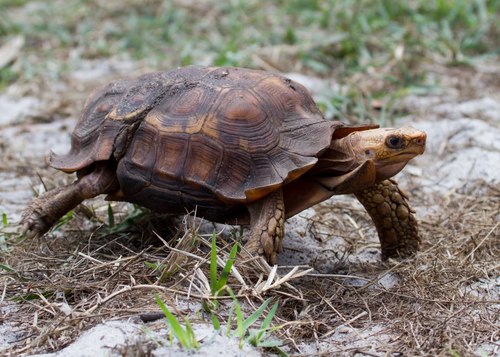
Eroded Hingeback Tortoise
Kinixys erosa
Featuring a unique biological 'hinge' that lets it seal its shell shut, the Eroded Hingeback Tortoise is a master of survival in the African rainforest. This shy, moisture-loving reptile is a vital part of the forest floor ecosystem.
Quick Identification
Size
Typically 20-32 cm (8-13 inches) in length; weighs between 1.5 and 3.5 kg (3.3-7.7 lbs).
Colors
Carapace is dark brown to mahogany with yellowish centers on the scutes; skin is grey-brown with occasional yellow scales on the head.
Key Features
- Movable hinge at the rear of the upper shell
- Serrated or 'eroded' appearance on the back edge of the shell
- Relatively flat and elongated carapace
- Strong, thick limbs adapted for forest floor navigation
When You’ll See Them
Geographic range
Where Does the Eroded Hingeback Tortoise Live?
This species is a quintessential inhabitant of the tropical forest belt of Western and Central Africa. Its native range spans from the coastal forests of Guinea and Liberia eastward through the Congo Basin into Uganda, reaching as far south as northern Angola. It is most frequently encountered in low-lying, humid environments where the canopy remains dense and the ground stays moist throughout the year.
Basemap © OpenStreetMap contributors
Behavior
The Eroded Hingeback Tortoise is a secretive and shy resident of the African rainforest floor. Its most remarkable adaptation is the 90-degree hinge located at the back of its upper shell (carapace), which allows the tortoise to close its rear end downwards to protect its vulnerable hind legs and tail from predators. Unlike many other tortoises that retreat into their shells from the front, this species uses its 'back door' as a primary defense mechanism.
These tortoises are much more moisture-dependent than their savannah-dwelling relatives. They are frequently observed soaking in shallow forest pools or emerging from hiding during heavy tropical downpours. While generally solitary, they are highly attuned to their environment, using a keen sense of smell to locate food across the forest floor. They are known to be quite docile, preferring to freeze or hide rather than engage in aggressive displays when encountering humans or larger animals.
EverydayEarth exclusive
Camera Tips
To successfully capture an Eroded Hingeback Tortoise on camera, you must focus on the 'micro-highways' of the forest floor. These tortoises rarely travel in wide-open spaces, preferring to skirt along the edges of fallen logs, buttress roots of large trees, or through established clearings in the leaf litter. Position your camera extremely low—no more than 4 to 6 inches (10-15 cm) off the ground—to ensure you capture the facial features and the distinct serrated edge of the shell rather than just a blurry top-down view.
Because they are highly attracted to fallen fruit, you can create a natural 'studio' by placing your camera near a fruiting tree or using a lure of overripe bananas or jackfruit. The scent will draw them out from their hiding spots under the brush. Since they are most active during high humidity, check your lens for fogging and ensure your camera is positioned in a spot that stays relatively dry during heavy rains to avoid water spots on the glass.
Adjust your trigger settings to be highly sensitive. As slow-moving animals, tortoises can sometimes fail to trigger a camera until they are halfway out of the frame. Using a 'burst mode' of 3-5 photos or setting a short video delay will ensure you capture the deliberate, rhythmic walking motion that makes these reptiles so fascinating to watch. Infrared (IR) night vision is essential, as they often forage during the dim twilight hours when forest light is at its lowest.
Similar Species
Species that look similar or are commonly confused with Eroded Hingeback Tortoise.
Frequently Asked Questions
Record Eroded Hingeback Tortoise at your habitat
Connect a camera to start building your own species record — AI identifies every visitor automatically.