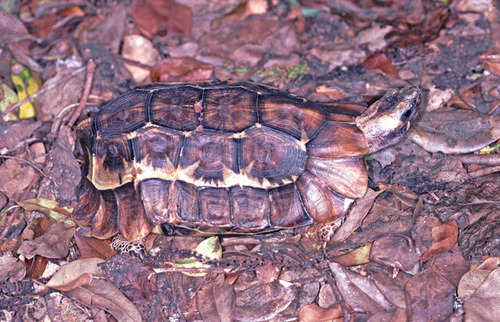
Home's Hingeback Tortoise
Kinixys homeana
Meet the forest's armored ghost, a unique tortoise with a literal 'hinge' on its back for ultimate protection. This critically endangered master of camouflage is one of the most specialized reptiles of the African rainforest floor.
Quick Identification
Size
15 to 22 cm (6 to 8.5 inches) in length; weighs 1 to 2 kg (2.2 to 4.4 lbs)
Colors
Mottled shades of brown, tan, and olive green; carapace scutes often feature yellowish centers or radiating patterns; yellowish plastron with dark blotches
Key Features
- Distinctive 90-degree hinge at the rear of the upper shell
- Flattened, 'depressed' carapace profile
- Sharply serrated or flared rear marginal scutes
- Prominent hooked beak on the upper jaw
When You’ll See Them
Geographic range
Where Does the Home's Hingeback Tortoise Live?
Native to the tropical forest belt of West and Central Africa, Home's Hingeback Tortoise is found from Guinea and Liberia eastward through Ivory Coast, Ghana, Togo, Benin, and Nigeria. Its range extends into the humid forests of Cameroon and the Democratic Republic of the Congo. This species is a true lowland specialist, rarely venturing outside the humid Guineo-Congolian rainforest block.
Basemap © OpenStreetMap contributors
Behavior
Home's Hingeback Tortoise is a reclusive and highly specialized forest dweller. Unlike many other tortoise species that seek out sunlight for basking, this species is adapted to the dim, humid environment of the African rainforest floor. Its most remarkable feature is a specialized hinge located at the back of its carapace, which allows the tortoise to close the rear portion of its shell downward. This protects its vulnerable hind legs and tail from predators while the tortoise remains tucked away.
These tortoises are primarily solitary and spend a significant portion of their lives hidden beneath leaf litter, fallen logs, or in the root buttresses of large trees. They are most active during the rainy season, as the high humidity levels and damp soil facilitate easier movement and provide an abundance of their favorite foods. When threatened, they are quick to retract and utilize their 'hinge' defense, often remaining motionless for long periods until the danger has passed.
EverydayEarth exclusive
Camera Tips
To successfully capture a Home's Hingeback Tortoise on camera, placement is the most critical factor. Because these tortoises are small and stay close to the ground, you must mount your camera extremely low—no more than 10 to 15 centimeters (4 to 6 inches) off the forest floor. Angle the lens slightly downward to ensure you catch the top of the shell, which is vital for identifying the species. Look for 'corridors' in the undergrowth, such as the space between large tree roots or alongside fallen logs, which these tortoises use as natural highways.
Timing is also essential. Home's Hingeback Tortoises are crepuscular, meaning they are most likely to be moving during the dim light of early morning or late afternoon. They are particularly active during or immediately after a rainstorm when the forest floor is saturated. Set your camera to a high-sensitivity motion trigger; because they move so slowly and have a low heat signature, they can sometimes fail to trigger less sensitive PIR sensors. A multi-shot burst mode is highly recommended to document their slow transit across the frame.
If you are monitoring a backyard or garden that borders a West African forest, you can attract them by creating a 'micro-habitat.' A pile of damp leaf litter or a very shallow, ground-level water basin can be a significant draw. While we generally advise against artificial feeding, the scent of overripe fruit like bananas or papayas can act as a powerful natural lure in a trail camera setup. Ensure your camera has excellent infrared night vision, as the deep shade of the rainforest often requires the camera to switch to IR mode even during the day.
Similar Species
Species that look similar or are commonly confused with Home's Hingeback Tortoise.
Frequently Asked Questions
Record Home's Hingeback Tortoise at your habitat
Connect a camera to start building your own species record — AI identifies every visitor automatically.