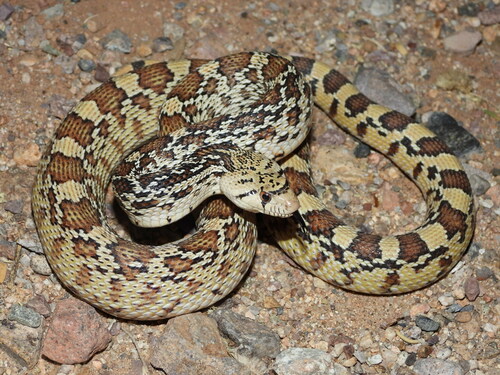
Gopher Snake
Pituophis catenifer
Often mistaken for a rattlesnake due to its bold patterns and defensive hiss, the Gopher Snake is actually a harmless, rodent-eating ally for any gardener. These impressive constrictors are one of the most beneficial and widely distributed reptiles in North America.
Quick Identification
Size
3 to 7 feet (91 to 213 cm) in length; typically 2 to 4 pounds (0.9 to 1.8 kg)
Colors
Cream or yellowish-tan background with a series of large, dark brown or black square-shaped blotches along the back; smaller spots on the sides; yellowish belly with black spots.
Key Features
- Large, dark rectangular blotches along the back
- Keeled scales giving a rough, non-glossy appearance
- Narrow head with a dark line running from the eye to the corner of the jaw
- Round pupils (unlike the vertical slits of rattlesnakes)
When You’ll See Them
Geographic range
Where Does the Gopher Snake Live?
Native to North America, the Gopher Snake occupies a massive geographic footprint that stretches from the southern provinces of Canada all the way to central Mexico. It is most prevalent throughout the Western United States, ranging from the Pacific Coast across the Great Plains. These snakes are incredibly hardy, thriving in environments as varied as the arid Mojave Desert, the coastal scrub of California, and the high-elevation meadows of the Rocky Mountains.
Basemap © OpenStreetMap contributors
Behavior
Gopher Snakes are one of the most commonly encountered reptiles in North America, known primarily for their impressive defensive displays. When threatened, they perform a convincing rattlesnake impersonation: they flatten their heads into a triangular shape, hiss loudly, and vibrate their tails rapidly against dry leaves or grass to create a buzzing sound. Despite this tough exterior, they are nonvenomous and generally reluctant to bite humans unless significantly provoked.
As powerful constrictors, they are solitary hunters that spend much of their time underground in rodent burrows or prowling through tall grass. They are diurnal, meaning they are most active during the day, though in the scorching heat of mid-summer, they often shift their activity to the cooler twilight hours or even become nocturnal. In the winter, they retreat to communal dens (hibernacula) to brumate until spring.
EverydayEarth exclusive
Camera Tips
Capturing a Gopher Snake on camera requires a different strategy than scouting for mammals. Since snakes are cold-blooded, traditional Passive Infrared (PIR) sensors—which trigger based on heat signatures—can sometimes fail to detect them against a warm ground surface. To improve your chances, place your camera in 'Time-Lapse' mode with short intervals (every 15-30 seconds) during the peak morning and late afternoon hours when they are most likely to be moving.
Position your camera at ground level, angled slightly downward. Snakes are creatures of habit and edge-dwellers; they prefer to travel along 'corridors' where they feel protected. Place your camera along the base of a garden wall, the edge of a tall grass line, or next to a woodpile. If you have a 'drift fence' (a low temporary barrier), snakes will often crawl along its length, making it the perfect spot for a clear side-profile shot.
Focus your efforts near potential 'basking' sites and hunting grounds. Flat rocks that catch the morning sun or the entrance to active rodent burrows are high-traffic areas. Because Gopher Snakes are large and move relatively slowly while foraging, you don't need a super-fast trigger speed, but high-resolution video can help you distinguish their unique scale patterns and behavior.
Similar Species
Species that look similar or are commonly confused with Gopher Snake.
Frequently Asked Questions
Record Gopher Snake at your habitat
Connect a camera to start building your own species record — AI identifies every visitor automatically.