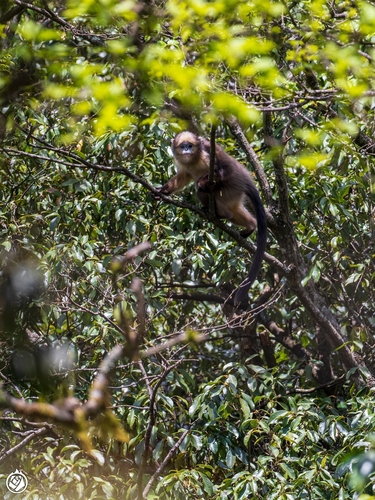
Grey Snub-nosed Monkey
Rhinopithecus brelichi
Meet the rarest of the 'Golden Monkeys,' a ghost of the Guizhou clouds found only on a single mountain in China. With its striking blue face and upturned nose, the Grey Snub-nosed Monkey is a true masterpiece of evolution.
Quick Identification
Size
Body length 64-73 cm (25-29 in); tail length 70-97 cm (27-38 in); weight 8-15 kg (18-33 lbs)
Colors
Predominantly slate-grey body with a distinct white diamond-shaped patch between the shoulder blades; yellowish-orange fur on the chest and inner limbs; pale blue skin around the eyes.
Key Features
- Distinctly upturned, flat nostrils
- Long tail significantly exceeding body length
- White patch between the shoulder blades
- Exposed blue skin surrounding the eyes
When You’ll See Them
Geographic range
Where Does the Grey Snub-nosed Monkey Live?
Native exclusively to the continent of Asia, the Grey Snub-nosed Monkey is one of the world's rarest primates, found only within a tiny geographic footprint. This species is strictly endemic to the Wuling Mountains of southwestern China, specifically restricted to the Fanjingshan National Nature Reserve in Guizhou Province. Unlike other snub-nosed species with broader distributions, this monkey survives in a single isolated population on this solitary mountain massif.
Basemap © OpenStreetMap contributors
Behavior
These monkeys are highly social primates that live in complex multi-level societies. They typically form small bachelor groups or family units consisting of one male and several females, which then aggregate into massive 'super-bands' that can include hundreds of individuals. Much of their day is spent foraging in the high-altitude canopy, though they are known to travel across the ground when crossing gaps in the forest or moving between preferred feeding sites.
Interaction with humans is extremely limited due to their remote habitat and shy nature. In the Fanjingshan National Nature Reserve, they are elusive and tend to retreat deep into the forest at the sound of human approach. Their communication involves a variety of vocalizations, ranging from soft contact calls to loud barks used to signal alarm or maintain group cohesion during movement through dense fog and thick vegetation.
EverydayEarth exclusive
Camera Tips
Capturing the Grey Snub-nosed Monkey on camera requires positioning equipment in the high-altitude forests of the Fanjingshan range. Because these primates spend the majority of their time in the canopy, cameras should ideally be mounted at heights of 5 to 10 meters on sturdy tree trunks, angled slightly downward toward high-traffic 'arboreal highways'—horizontal branches that show signs of frequent use, such as worn bark or proximity to seasonal fruit. If ground-level capture is the goal, focus on natural corridors between forest patches where the monkeys are forced to descend to the ground to travel.
Since these monkeys are extremely sensitive to human presence and unfamiliar objects, high-quality camouflage and 'no-glow' (940nm) infrared LEDs are essential to prevent spooking them at night or in low-light conditions. Standard white-flash cameras will likely cause the troop to avoid the area for weeks. Set your camera to a fast trigger speed (0.2 seconds or less) and use 'burst mode' to capture their rapid leaps through the trees. Video mode is particularly effective for documenting their complex social grooming behaviors during midday rest periods.
Timing and location are critical for success. The monkeys are most active during the early morning and late afternoon when they move between sleeping sites and feeding grounds. During the winter months, they may descend to slightly lower elevations to find food, making the 1,500-1,800 meter zone more productive. Avoid using food lures, as these are wild, critically endangered animals; instead, focus on placing cameras near known seasonal food sources like fruiting trees or areas with heavy lichen growth on the bark.
Similar Species
Species that look similar or are commonly confused with Grey Snub-nosed Monkey.
Frequently Asked Questions
Record Grey Snub-nosed Monkey at your habitat
Connect a camera to start building your own species record — AI identifies every visitor automatically.