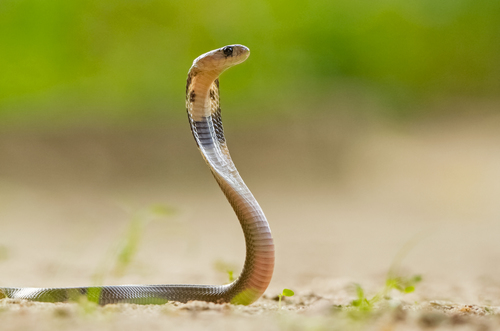
Indian Cobra
Naja naja
The Indian Cobra is a symbol of power and grace, recognized globally for its magnificent hood and vital role in South Asian ecosystems. As a master rodent hunter, it is a frequent but elusive visitor to backyards across the subcontinent.
Quick Identification
Size
Typically 1.2 to 1.5 metres (4 to 5 feet) in length; record specimens can reach up to 2.2 metres (7.2 feet).
Colors
Highly variable ranging from tan, olive-brown, and grey to nearly black; most feature the iconic white or yellow 'spectacle' mark on the hood's rear and dark twin spots on the throat.
Key Features
- Distinctive expandable neck hood with 'spectacle' marking
- Smooth, glossy dorsal scales
- Large, dark eyes with round pupils
- Two dark spots on the ventral side of the hood
When You’ll See Them
Geographic range
Where Does the Indian Cobra Live?
Native to the diverse ecosystems of the Indian subcontinent, the Indian Cobra occupies a massive geographical range that spans from the arid plains of Pakistan to the lush tropical landscapes of Sri Lanka. It is found throughout almost the entirety of mainland India, Bangladesh, and Nepal, including the foothills of the Himalayas. While it is a lowland specialist, its ability to thrive in human-modified landscapes makes it one of the most widely distributed venomous snakes in South Asia.
Basemap © OpenStreetMap contributors
Behavior
The Indian Cobra is a highly alert and defensive snake that is best known for its iconic 'hooding' display. When threatened, it raises the anterior third of its body and spreads its elongated cervical ribs to create a wide hood, accompanied by a loud, intimidating hiss. Despite their fearsome reputation, they generally prefer to avoid human contact and will usually retreat if given a clear escape route. They are solitary creatures that primarily interact during the mating season.
These snakes are incredibly adaptable in their activity patterns; while primarily diurnal or crepuscular, they often become more active at night in areas with high human traffic or during extreme heat. Their behavior is heavily influenced by the availability of prey, particularly rodents, which often brings them into close proximity with agricultural areas and suburban homes. They are capable swimmers and can climb trees in search of food, though they are primarily terrestrial hunters.
EverydayEarth exclusive
Camera Tips
Capturing an Indian Cobra on a backyard or trail camera requires a focus on 'pinch points' where they are likely to travel in search of rodents. Look for gaps under garden sheds, woodpiles, or stone walls. Because these snakes are relatively low to the ground, your camera should be mounted no more than 6-10 inches high. Aiming the camera slightly downward along a wall or fence line is often more effective than pointing it across a wide-open space, as cobras prefer to stay near cover while moving.
Since the Indian Cobra is frequently active during both day and night, ensure your camera has a high-quality PIR (Passive Infrared) sensor and a fast trigger speed. Cold-blooded reptiles don't always trigger standard heat sensors as reliably as mammals, so setting your camera to its highest sensitivity or using a 'Time Lapse' mode with 1-minute intervals can help capture movement that the sensor might miss. High-resolution video is preferable to stills, as it allows you to see the snake's movement and potentially identify the hood markings if it becomes alert.
Safety is paramount when working in cobra territory. Never place a camera in a hole or crevice without checking it thoroughly from a distance first, and always wear sturdy boots and long trousers. If you are using a lure, remember that you aren't luring the snake directly; instead, focus on attracting its prey. Maintaining a bird feeder or a small brush pile that attracts mice will naturally bring cobras into the camera's field of view over time. Avoid handling the camera at night or in low light when the snakes are more difficult to spot in the grass.
Similar Species
Species that look similar or are commonly confused with Indian Cobra.
Frequently Asked Questions
Record Indian Cobra at your habitat
Connect a camera to start building your own species record — AI identifies every visitor automatically.