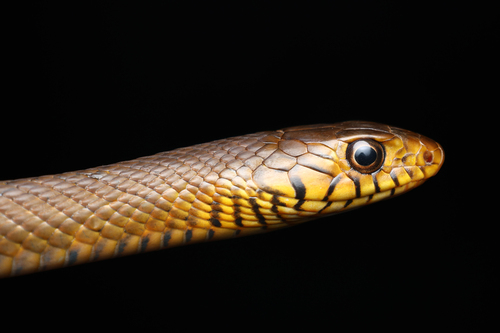
Oriental Rat Snake
Ptyas mucosa
The Oriental Rat Snake is a fast-moving, non-venomous marvel of the backyard. Known for its incredible agility and role as a master of rodent control, this impressive serpent is a sign of a healthy, balanced ecosystem.
Quick Identification
Size
Typically 1.5 to 1.95 m (5 to 6.4 ft), with records reaching 3.7 m (12.1 ft); weighs between 0.9 and 2.5 kg (2 to 5.5 lbs).
Colors
Variable from olive-green or pale brown to nearly black, often featuring dark cross-bands on the posterior and tail; belly is cream to pale yellow.
Key Features
- Large prominent eyes with round pupils
- Black vertical lines on the labial (lip) scales
- Slender, athletic build with a long tapering tail
- Fast-moving, whip-like agitation when startled
When You’ll See Them
Geographic range
Where Does the Oriental Rat Snake Live?
The Oriental Rat Snake is a widespread species native to the vast stretches of South and Southeast Asia. Its territory begins in the west from Afghanistan and Pakistan, extending across the entire Indian subcontinent including Sri Lanka and Nepal, and moving east through Bangladesh into Myanmar, Vietnam, Thailand, and Indonesia. It is a highly successful generalist that has thrived in almost every country within the tropical and subtropical zones of the Asian continent.
Basemap © OpenStreetMap contributors
Behavior
The Oriental Rat Snake is a highly energetic and intelligent predator. Unlike many other snakes that rely on ambush tactics, this species is an active hunter, using its keen eyesight and incredible speed to chase down prey. It is strictly diurnal, meaning it is most active during daylight hours, often seen crossing roads or gliding through garden undergrowth in search of its next meal.
While non-venomous and generally shy around humans, the Oriental Rat Snake is famous for its defensive displays. If cornered, it can inflate its neck—though vertically rather than horizontally like a cobra—and emit a deep, guttural hiss. This behavior, combined with its impressive size, often leads to it being mistaken for more dangerous species, yet it remains a harmless and beneficial neighbor that provides excellent natural pest control.
EverydayEarth exclusive
Camera Tips
To capture the Oriental Rat Snake on a backyard camera, placement is everything. These snakes are creatures of habit and often use 'wildlife highways' such as the base of a garden wall, the edge of a fence line, or the perimeter of a thick hedge. Position your camera about 6 to 10 inches off the ground, facing parallel to these linear features. Because they move with surprising speed, ensure your camera has a fast trigger speed and is set to record video rather than just still photos; a 15-second clip is usually enough to capture their graceful transit.
While you cannot easily bait a snake, you can bait their food source. A bird feeder that drops seeds or a well-maintained compost pile will attract mice and rats, which in turn acts as a natural magnet for the Oriental Rat Snake. If you have a rock pile or a large flat stone in a sunny spot, aim your camera there. These snakes are cold-blooded and will often spend the first few hours of the morning basking in the sun to warm up before they begin hunting.
Mid-morning is the 'golden hour' for snake activity, especially after a cool night. During the monsoon or rainy seasons, these snakes become even more active as frogs emerge. If your camera supports it, use a high frame rate to capture the flicker of their tongue and their smooth, undulating movement. Remember to keep the area immediately in front of the lens clear of tall grass, as a single blade of grass blowing in the wind can trigger the camera and fill your SD card before the snake even arrives.
Similar Species
Species that look similar or are commonly confused with Oriental Rat Snake.
Frequently Asked Questions
Record Oriental Rat Snake at your habitat
Connect a camera to start building your own species record — AI identifies every visitor automatically.