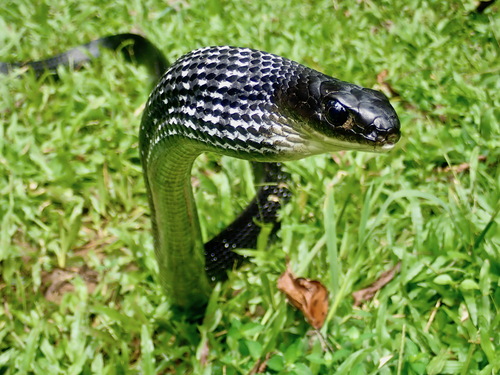
Keeled Rat Snake
Ptyas carinata
The Keeled Rat Snake is a true titan of the colubrid family, reaching lengths that challenge some pythons. This agile, non-venomous predator is a master of the Southeast Asian underbrush, known for its distinctive ridged scales and lightning-fast hunting style.
Quick Identification
Size
1.2–2.75 m (4–9 ft) average; maximum recorded up to 4 m (13 ft); weight typically 2–7 kg (4.4–15.4 lbs)
Colors
Olive-brown to grayish-black body; darker toward the tail; cream or yellowish belly; distinct black edging on scales
Key Features
- Pronounced ridges or 'keels' on dorsal scales
- Massive length, the largest of all colubrid snakes
- Large eyes with round pupils for diurnal hunting
- Slender but muscular build with a tapering tail
When You’ll See Them
Geographic range
Where Does the Keeled Rat Snake Live?
The Keeled Rat Snake is native to the lush, tropical landscapes of Southeast Asia. Its core range extends from the mainland regions of Myanmar, Thailand, Cambodia, Vietnam, and Laos, stretching southward through the Malay Peninsula into Singapore. It is also widely distributed across the island nations of Indonesia and the Philippines, reaching as far north as the subtropical forests of Taiwan.
Basemap © OpenStreetMap contributors
Behavior
The Keeled Rat Snake is a diurnal powerhouse, spending its daylight hours actively hunting for prey across the forest floor and low-hanging branches. Despite its intimidating size, which can rival some pythons, it is non-venomous and relies on its incredible speed and agility to overpower targets. It is known to be a shy species that will usually flee into the brush at the first sign of human activity, making it a rare treat to capture on camera.
When cornered, however, this snake can put on a formidable defensive display. It may inflate its neck to appear larger and strike repeatedly to deter threats. In the wild, they are solitary creatures, only coming together during the mating season. They are excellent climbers and are just as comfortable navigating the canopy as they are the leaf litter, often using their keen eyesight to spot movement from a distance.
EverydayEarth exclusive
Camera Tips
To capture the Keeled Rat Snake on an AI-powered camera, placement is everything. These snakes are highly active hunters that frequently patrol the perimeter of forests or long stone walls where lizards—one of their favorite meals—like to bask. Position your camera about 12 to 18 inches off the ground, angled slightly downward to cover a wide patch of ground. Focus on transition zones, such as the area where a garden meets dense woodland or near the base of large, fallen logs.
Because these snakes move with incredible speed, you should set your camera to its highest trigger sensitivity and use 'Burst Mode' or high-frame-rate video. A slow trigger will often result in a photo of a disappearing tail. Since they are diurnal, ensure your camera's exposure settings are optimized for dappled sunlight, as they often move through mixed light conditions under the canopy.
While you shouldn't use food bait to attract snakes, you can increase your chances by monitoring 'hotspots' for their prey. If you have a birdbath or a pond that attracts frogs and lizards, placing a camera nearby is a great strategy. In backyard settings, they are often attracted to woodpiles or rockeries that house rodents. During the hottest parts of the day, they may seek out shaded, damp areas, so a camera pointed at a cool, recessed garden feature can be very productive.
Similar Species
Species that look similar or are commonly confused with Keeled Rat Snake.
Frequently Asked Questions
Record Keeled Rat Snake at your habitat
Connect a camera to start building your own species record — AI identifies every visitor automatically.