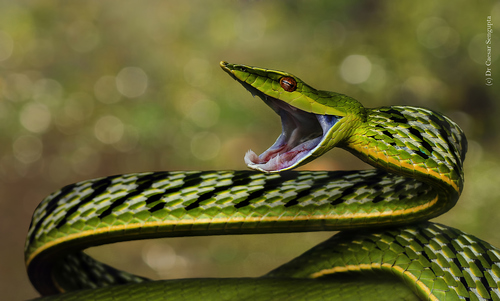
Indian Vine Snake
Ahaetulla oxyrhynca
A master of disguise and a marvel of evolution, the Indian Vine Snake is one of the most graceful predators in the backyard canopy. With its needle-thin profile and striking binocular vision, it turns the simple act of hunting into a high-stakes game of hide-and-seek.
Quick Identification
Size
1.2 to 1.8 meters (4 to 6 feet) in length; extremely slender body often no thicker than a human thumb.
Colors
Brilliant leaf green or fluorescent green dorsally; pale yellow or creamy white underside. Shows a black and white checkered pattern when the neck is inflated in a defensive display.
Key Features
- Extremely long and pointed snout with a flexible tip
- Horizontal 'keyhole' pupils providing binocular vision
- Slender, whip-like body designed for arboreal camouflage
- Slow, rhythmic swaying movement mimicking a vine in the wind
When You’ll See Them
Geographic range
Where Does the Indian Vine Snake Live?
The Indian Vine Snake is native to the Indian subcontinent, specifically endemic to the drier, semi-arid regions of Peninsular India. Its core range spans across the central and southern states of India, often found in lower densities toward the foothills of the Himalayas. While related species inhabit the wetter rainforests of the Western Ghats, the Indian Vine Snake is the most common green snake encountered in suburban gardens and agricultural landscapes across the Indian plains.
Basemap © OpenStreetMap contributors
Behavior
The Indian Vine Snake is a master of patience and camouflage. Unlike many snakes that flee at the first sign of movement, this species relies on its incredible resemblance to a green vine to remain undetected by both predators and prey. It often sits perfectly still for hours, or moves with a slow, swaying motion that mimics a branch caught in a breeze. While it is mildly venomous, it is generally docile and poses no threat to humans, though it may gape its mouth wide to show its dark interior and inflate its neck to look more intimidating if cornered.
This species is highly intelligent for a reptile, possessing specialized binocular vision that allows it to track moving prey with incredible precision. They are strictly diurnal, meaning they are active during the day and retreat to the higher canopy or deep within thick shrubs at night to sleep. Interestingly, they are known for a unique 'tongue-flicking' behavior where they hold their tongue out for extended periods to gather chemical cues from the air without the rapid, repetitive flickering seen in most other snake species.
EverydayEarth exclusive
Camera Tips
Capturing an Indian Vine Snake on an AI-powered camera requires a specialized setup because they are almost exclusively arboreal. Placing a camera on the ground or a low tripod will likely result in missed sightings. Instead, mount your camera at eye level—roughly 4 to 6 feet high—facing thick hedges, garden trellises, or the outer branches of fruit trees. Because they are so slender and move with agonizing slowness, set your camera's motion sensitivity to its highest level to ensure the trigger catches their subtle movement.
Lighting is crucial for this species. Avoid placing cameras where they face the harsh midday sun, as the glare off the snake's smooth, waxy scales can wash out the details. The best footage is typically captured during the 'golden hours' of the early morning or late afternoon. If your camera supports pre-roll video, enable it; vine snakes often pause for long periods before entering a new space, and pre-roll ensures you catch the full sequence of them gliding into the frame.
To increase your chances of a 'visit,' focus your camera on areas where their prey congregates. A garden with plenty of Garden Calotes (lizards) or a small birdbath in a shrubby corner is a prime hunting ground. Because the Indian Vine Snake is a visual hunter, they are attracted to movement, so a backyard that is wildlife-friendly and pesticide-free will naturally attract them. Use a high-resolution setting (2K or 4K) if possible, as their thin profile can be difficult to see in lower-resolution footage against a complex background of leaves.
Similar Species
Species that look similar or are commonly confused with Indian Vine Snake.
Frequently Asked Questions
Record Indian Vine Snake at your habitat
Connect a camera to start building your own species record — AI identifies every visitor automatically.