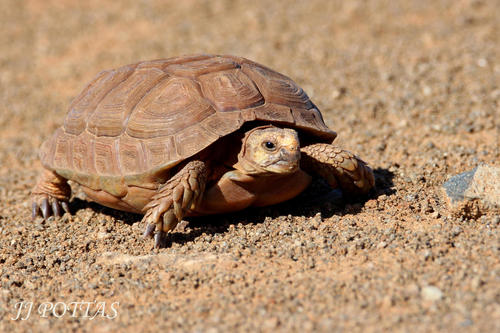
Karoo Tortoise
Homopus femoralis
Meet the rugged mountaineer of the tortoise world. The Karoo Tortoise is a high-altitude specialist, easily identified by its spurred thighs and its ability to thrive in the chilly South African Highveld.
Quick Identification
Size
Carapace length 10–16 cm (4–6.3 inches); weight 300–600g (0.6–1.3 lbs)
Colors
Carapace ranges from olive-green to reddish-brown with dark-edged scutes; plastron is usually yellowish or greenish-yellow
Key Features
- Large conical tubercles (spurs) on the back of the thighs
- Four claws on both front and hind feet
- Highly domed shell with a slightly serrated rear margin
- Largest species within the Homopus genus
When You’ll See Them
Geographic range
Where Does the Karoo Tortoise Live?
Native to the African continent, the Karoo Tortoise is an endemic resident of South Africa. Its core range is concentrated in the high-altitude interior, spanning the Great Karoo and the rocky Escarpment across the Free State and Eastern Cape provinces. It thrives in the rugged, elevated landscapes of the South African Highveld, rarely descending into the lower coastal plains occupied by its relatives.
Basemap © OpenStreetMap contributors
Behavior
The Karoo Tortoise, also known as the Greater Padloper, is a hardy high-altitude specialist. Unlike many other tortoises that retreat during cold snaps, this species is remarkably cold-tolerant, often seen basking on sunny rocks even when ambient temperatures are low. They are generally solitary and shy, retreating into rock crevices or under dense shrubs at the first sign of a predator or human interference.
These tortoises are strictly diurnal, timing their activity to coincide with peak sunlight to regulate their body temperature. They are not particularly territorial but tend to stay within a familiar home range where they know the best locations for food and shelter. During the breeding season, males become more active and may engage in mild head-bobbing displays when encountering females.
EverydayEarth exclusive
Camera Tips
To capture the Karoo Tortoise on camera, you must think low. Position your camera just 5 to 10 inches above the ground, ideally near rocky outcrops or "tortoise paths"—subtle tracks where the grass is slightly flattened. Because these reptiles are relatively small, an upward-tilted angle from a ground-level mount often produces the most dramatic and clear identification shots.
Look for north-facing rocky slabs where the tortoises gather to bask in the morning sun. These basking spots are prime locations for trail cameras. Since these tortoises are attracted to specific local flora, placing your camera near flowering succulents or bright orange-yellow Karoo wildflowers can act as a natural lure. In particularly dry periods, a very shallow water dish buried level with the soil is an excellent way to encourage them to linger in front of the lens.
Set your camera to a high-sensitivity motion trigger with a short burst mode (3–5 photos). While tortoises are slow, the Karoo Tortoise can move with surprising purpose when crossing open ground, and a single photo might only catch the back half of the shell. Using a camera with a high-resolution sensor is helpful for zooming in to count the claws on the feet or see the femoral tubercles, which are essential for distinguishing this species from the similar Parrot-beaked Tortoise.
Similar Species
Species that look similar or are commonly confused with Karoo Tortoise.
Frequently Asked Questions
Record Karoo Tortoise at your habitat
Connect a camera to start building your own species record — AI identifies every visitor automatically.