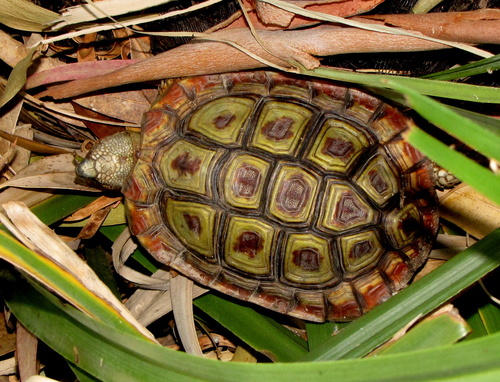
Parrot-beaked Tortoise
Homopus areolatus
The Parrot-beaked Tortoise is a colorful miniature marvel of the Cape. Known for its distinctive 'beak' and vibrant spring colors, this tiny resident is a master of navigating South African backyards.
Quick Identification
Size
A tiny tortoise reaching 8–11 cm (3–4.3 inches) in shell length; weight ranges from 140–300g (5–10.5 oz).
Colors
Olive, brownish, or orange carapace with dark-edged scutes. Males develop bright orange or red coloration on their heads and necks during mating season.
Key Features
- Prominent hooked, parrot-like upper beak
- Five toes on each forefoot
- Serrated edges on the back of the shell
- Small, low-profile body for navigating dense scrub
When You’ll See Them
Geographic range
Where Does the Parrot-beaked Tortoise Live?
This miniature reptile is a South African endemic, meaning it is found nowhere else on Earth. Its native range is concentrated in the southern coastal regions, spanning from the Western Cape across to the Eastern Cape. It is particularly common in the Mediterranean-climate zones of the Cape Floristic Region, though it occasionally ranges slightly further inland into the semi-arid Karoo where scrub cover is sufficient.
Basemap © OpenStreetMap contributors
Behavior
The Parrot-beaked Tortoise is a shy and largely solitary creature that spends its day navigating the dense undergrowth of the South African scrub. Despite their small size, they are surprisingly active and agile, capable of climbing over small rocks and through thick vegetation. They are diurnal, timing their activity to avoid the extreme heat of the afternoon, and are often seen basking in the morning sun to regulate their body temperature.
During the spring breeding season, males become uncharacteristically bold. They engage in ritualized head-bobbing to signal dominance or attract mates. In suburban environments, they have learned to navigate garden paths and often use backyard flower beds as safe corridors. While they don't seek out human interaction, they are relatively tolerant of activity nearby as long as they have a quick retreat into a bush or under a rock.
EverydayEarth exclusive
Camera Tips
To successfully capture a Parrot-beaked Tortoise on camera, you must think small. These tortoises are only a few inches tall, so a standard fence-post camera mount will likely miss them entirely. Position your AI camera no more than 6 to 10 inches off the ground. Angle the lens slightly downward (about 15-20 degrees) toward a known pathway or a sunny patch of ground where they might bask.
Look for 'micro-trails' in your garden—small, cleared paths through the mulch or leaf litter. Placing a camera near a shallow, ground-level water dish is one of the most effective ways to trigger a recording, as these tortoises regularly visit water sources to drink and soak during the dry months. They are also highly attracted to bright yellow or red flowers; if you have fallen hibiscus or gazania blooms, focus your camera on that area.
Because they move slowly, set your camera to a video mode rather than just photos. A 10-second clip will give the AI more time to identify the specific shell patterns and the movement of the head. Since they are most active in the morning, ensure your camera isn't facing directly into the rising sun, which can wash out the image and prevent the AI from recognizing the tortoise's unique olive and orange colors.
Lastly, consider the season. While they are year-round residents, your best footage will come in the spring (September to November) when males are actively searching for mates. Their bright orange facial markings during this time make for spectacular high-definition captures. If your camera allows for focal adjustments, set it to a shorter range (1-3 meters) to ensure these tiny subjects stay in crisp focus.
Similar Species
Species that look similar or are commonly confused with Parrot-beaked Tortoise.
Frequently Asked Questions
Record Parrot-beaked Tortoise at your habitat
Connect a camera to start building your own species record — AI identifies every visitor automatically.