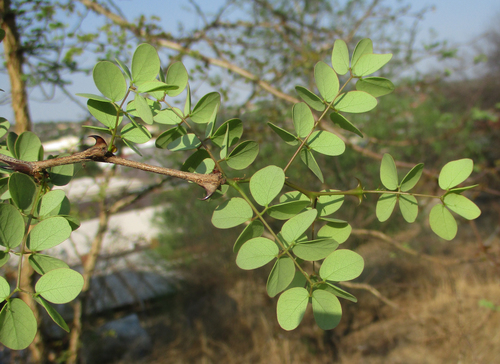
knobthorn
Senegalia nigrescens
The Knobthorn is the rugged sentinel of the African bush, easily identified by its unique 'knobby' bark and clouds of white spring blossoms. A favorite of giraffes and leopards alike, this tree is a bustling hub for savanna wildlife.
Quick Identification
Size
A medium to large tree reaching heights of 8 to 18 metres (26 to 60 feet), with a trunk diameter up to 0.75 metres (2.5 feet).
Colors
Dark grey to blackish bark; creamy-white to pale yellow flowers; bright green foliage that turns yellow before dropping.
Key Features
- Distinctive woody knobs on the trunk and branches topped with small black thorns
- Cylindrical, creamy-white flower spikes that appear before the leaves in spring
- Hooked, paired thorns found just below the leaf nodes
- Hard, heavy dark-brown heartwood highly resistant to decay
When You’ll See Them
Geographic range
Where Does the knobthorn Live?
The Knobthorn is native to the vast savanna regions of Sub-Saharan Africa. Its range extends from the northern reaches of Ethiopia and Somalia, stretching down through East African countries like Tanzania and Kenya, into the heart of Southern Africa. It is particularly abundant in the lowveld regions of South Africa, Zimbabwe, Botswana, and Mozambique, where it thrives in frost-free environments.
Basemap © OpenStreetMap contributors
Behavior
The Knobthorn is a cornerstone of the African savanna ecosystem, known for its slow-growing nature and incredible resilience. As a deciduous tree, it drops its leaves during the dry winter months to conserve water, often standing as a stark, architectural silhouette against the horizon. It is one of the first trees to bloom in early spring, producing a spectacular display of fragrant flower spikes that attract a wide variety of pollinators, including bees and butterflies.
Ecologically, the Knobthorn is a vital provider. Its high-protein leaves and pods are a preferred food source for giraffes, elephants, and various antelope species. Interestingly, the tree has a symbiotic relationship with ants that may live within its thorns, and it is famously termite-resistant. While it doesn't 'behave' in the animal sense, its presence dictates the movement of wildlife, acting as a high-nutrition cafeteria for megaherbivores and a sturdy nesting site for birds of prey like vultures and eagles.
EverydayEarth exclusive
Camera Tips
When using an AI-powered camera to capture wildlife, treating a Knobthorn tree as your primary 'set' is a winning strategy. Because of its high nutritional value, these trees are magnets for giraffes and elephants. Position your camera on a nearby post or a different tree species at a height of 1.5 to 2 metres, angled slightly upward if you are hoping to catch the iconic sight of a giraffe's long tongue stripping leaves from the upper canopy. If you are targeting smaller browsers like impala or kudu, keep the camera at chest height (about 1 metre).
The Knobthorn’s sturdy, horizontal branches are also favorite lounging spots for leopards. If you find a tree with a large, accessible limb, consider mounting a camera higher up (3-4 metres) if you can do so safely, or use a long-range lens from a distance. The flowering season in late winter/early spring is the best time for vibrant shots, as the white blossoms provide a beautiful contrast against the blue African sky and attract a flurry of bird activity.
Since these trees are often found in open savanna, lighting can be harsh. Set your camera to trigger most frequently during the 'golden hours' of dawn and dusk. For backyard setups in African suburban areas, planting a Knobthorn can turn your yard into a sanctuary, but be sure the camera is protected; elephants are known to push these trees over or strip the bark, which could easily take out a poorly placed camera housing.
Similar Species
Species that look similar or are commonly confused with knobthorn.
Frequently Asked Questions
Record knobthorn at your habitat
Connect a camera to start building your own species record — AI identifies every visitor automatically.