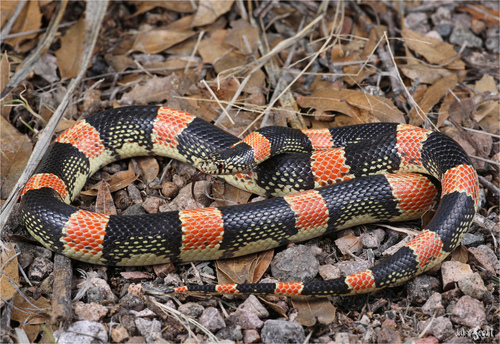
Long-nosed Snake
Rhinocheilus lecontei
Meet the desert’s most colorful nocturnal specialist. With its distinctive pointed snout and striking tricolor bands, the Long-nosed Snake is a master of the midnight shift in the American Southwest.
Quick Identification
Size
56–81 cm (22–32 inches) in length, with rare specimens reaching up to 104 cm (41 inches).
Colors
Cream or pale yellow base with bold black saddles. The spaces between the black markings often feature vibrant red or orange speckling, giving them a tri-colored appearance.
Key Features
- Distinctive elongated, upturned snout (rostral scale)
- Smooth, glossy scales that lack keels
- Single row of subcaudal scales under the tail
- Tri-colored pattern mimicking venomous snakes
When You’ll See Them
Geographic range
Where Does the Long-nosed Snake Live?
Native to the North American continent, the Long-nosed Snake is a staple of the southwestern United States and northern Mexico. Its range extends from the coastal regions of California and the San Joaquin Valley eastward through the Great Basin and the Mojave, Sonoran, and Chihuahuan Deserts, reaching as far as Kansas, Oklahoma, and central Texas. South of the border, it is found throughout the Baja Peninsula and across the Mexican Plateau as far south as San Luis Potosí.
Basemap © OpenStreetMap contributors
Behavior
The Long-nosed Snake is a primarily nocturnal species, spending the vast majority of the daylight hours buried in loose soil or hiding within abandoned rodent burrows. This secretive lifestyle makes them a rare sight for casual hikers, but they are quite active after dark when temperatures drop. They are excellent burrowers, using their specialized, reinforced snout to push through sandy or loamy substrate in search of prey or refuge.
When threatened, this snake has one of the most unusual defensive displays in the reptile world. While they are docile and rarely bite, they may vibrate their tails like a rattlesnake or, more surprisingly, expel a mixture of musk and blood from their cloaca (a process known as autohemorrhaging). This unpleasant cocktail is usually enough to deter any predator looking for a quick snack. In human-populated areas, they are harmless neighbors that provide excellent natural pest control for garden-dwelling lizards.
EverydayEarth exclusive
Camera Tips
To capture a Long-nosed Snake on camera, you must focus on their nocturnal habits and ground-level movement. Place your camera very low—ideally no more than 2 to 4 inches off the ground—and angle it slightly downward. These snakes often travel along 'edges,' such as the base of a garden wall, a fence line, or the boundary where desert scrub meets a cleared path. Using a wide-angle lens setting is beneficial, as it allows you to see the snake's full length as it passes through the frame.
Because snakes are ectothermic (cold-blooded), they don't always trigger standard Passive Infrared (PIR) sensors as reliably as warm-blooded mammals. To increase your chances, set your AI camera to 'Time-Lapse' mode during the first four hours after sunset, or increase the PIR sensitivity to its highest setting. If your camera allows for it, a hybrid mode that uses both a timer and a motion trigger is the gold standard for recording these elusive reptiles.
Focus your efforts near natural features that attract their favorite prey: lizards. Rock piles, old wood heaps, or the base of prickly pear cacti are high-traffic zones. If you live in a particularly dry area, a very shallow water saucer placed near a bush can attract both the snake and the lizards it hunts, creating a perfect focal point for your lens. Avoid using bright white flashes, which can startle the snake; instead, utilize 'No-Glow' or 'Black' infrared LEDs to capture natural behavior without detection.
Seasonality is key for this species. In the American Southwest, the best time to capture footage is during the 'monsoon' season or immediately following spring rains. The increased humidity and slightly cooler nights bring Long-nosed Snakes out in much higher numbers as they search for mates or hunt active lizards. During these peaks, you might even capture their unique 'side-winding' type of locomotion if they are moving across particularly loose sand.
Similar Species
Species that look similar or are commonly confused with Long-nosed Snake.
Frequently Asked Questions
Record Long-nosed Snake at your habitat
Connect a camera to start building your own species record — AI identifies every visitor automatically.