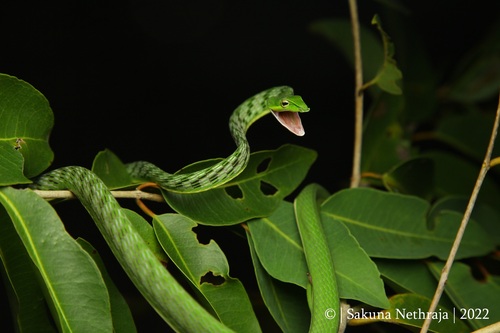
Long-nosed Whipsnake
Ahaetulla nasuta
A master of arboreal disguise, the Long-nosed Whipsnake is a vibrant green marvel native only to Sri Lanka. With its unique 'keyhole' pupils and needle-thin body, it flows through the trees with the grace of a swaying vine.
Quick Identification
Size
1.5 to 2 metres (5 to 6.5 feet) in length; extremely slender body often no wider than a finger
Colors
Bright leaf-green or fluorescent green overall; yellow or white line along the belly; black and white checkered patterns visible between scales when defensive
Key Features
- Elongated snout ending in a soft, fleshy point
- Horizontal 'keyhole' pupils providing binocular vision
- Incredibly slender, vine-like body
- Vibrant green coloration for canopy camouflage
When You’ll See Them
Geographic range
Where Does the Long-nosed Whipsnake Live?
This elegant reptile is a true island specialist, found exclusively in the tropical landscapes of Sri Lanka. While it was once thought to inhabit much of Southern Asia, recent taxonomic studies have restricted the true Long-nosed Whipsnake population to this teardrop-shaped island in the Indian Ocean. It is widely distributed across the island's wet and intermediate zones, thriving in both pristine forests and well-vegetated human settlements.
Basemap © OpenStreetMap contributors
Behavior
The Long-nosed Whipsnake is a diurnal and highly arboreal predator, spending almost its entire life in the canopy or within dense shrubs. It is famous for its 'swaying' movement, where it rocks its body back and forth to mimic a thin vine moving in the wind. This clever mimicry allows it to approach prey undetected and hide from larger predators like birds of prey.
While it is mildly venomous, it is generally docile toward humans and prefers to flee into the foliage. When threatened, it displays a fascinating defensive posture by inflating its neck to reveal a striking black-and-white checkered pattern on the skin beneath its green scales, while keeping its mouth open to intimidate the intruder. Unlike most snakes, it possesses binocular vision, which is essential for accurately striking fast-moving lizards among tangled branches.
EverydayEarth exclusive
Camera Tips
To capture the Long-nosed Whipsnake on a backyard camera, you must think vertically. These snakes are rarely found on the ground, so mounting your camera on a fence post or a tree trunk at eye level (4-6 feet) is the best strategy. Aim your lens toward dense clusters of foliage or 'bridge' branches where a snake might travel between trees. Because their green color provides perfect camouflage, a high-resolution 4K camera is recommended to distinguish the snake from the surrounding leaves.
Traditional motion sensors can struggle with this species because they move very slowly and have a low thermal signature. Use a camera with high-sensitivity PIR settings or, better yet, a camera that utilizes AI pixel-change detection to trigger recordings. Setting your camera to record video rather than still photos is highly recommended, as the snake’s unique swaying motion is one of its most identifiable and interesting traits.
Place your camera near features that attract their prey. A garden pond that hosts frogs or a stone wall where lizards bask are high-traffic areas for a hunting whipsnake. Early morning light is ideal for photography, as the low sun angle highlights the snake's texture and its unique horizontal pupils. Ensure the area in front of the lens is clear of small twigs that might blow in the wind, which could cause false triggers and fill up your SD card.
Similar Species
Species that look similar or are commonly confused with Long-nosed Whipsnake.
Frequently Asked Questions
Record Long-nosed Whipsnake at your habitat
Connect a camera to start building your own species record — AI identifies every visitor automatically.