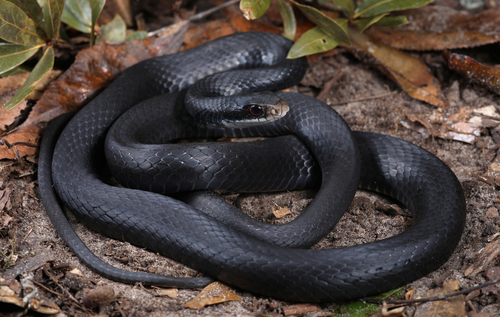
North American Racer
Coluber constrictor
Meet the North American Racer, the sleek, high-speed predator of the backyard. Known for its incredible agility and curious 'periscoping' behavior, this nonvenomous snake is a master of the daytime hunt.
Quick Identification
Size
20 to 60 inches (50 to 152 cm) in length; typically weighs 1 to 2 lbs (450 to 900 g)
Colors
Adults are solid black, blue, or olive-green with a pale white or yellow chin; juveniles are gray with reddish-brown blotches.
Key Features
- Solid uniform coloring with a distinct pale white or cream-colored chin and throat
- Large, prominent eyes with round pupils and keen eyesight
- Smooth, glossy scales that lack ridges (non-keeled)
- Slender, whip-like body designed for high-speed movement
When You’ll See Them
Geographic range
Where Does the North American Racer Live?
The North American Racer is native to the North American continent, boasting one of the most expansive ranges of any snake in the region. Its territory stretches from southern Canada throughout nearly the entire United States—excluding the high peaks of the Rockies—and extends southward through Mexico into Guatemala and Belize. These snakes are a common sight in almost every state in the lower 48, thriving in diverse ecosystems from the humid Southeast to the arid grasslands of the West.
Basemap © OpenStreetMap contributors
Behavior
The North American Racer is a high-energy, diurnal snake known for its incredible speed and visual hunting style. Unlike many other snakes that rely on ambush tactics, the Racer actively patrols its territory during the day, often lifting its head well above the grass—a behavior known as "periscoping"—to survey its surroundings for movement. They are exceptionally agile and can climb low bushes or swim if necessary to pursue prey or escape a predator.
In interactions with humans, Racers are notably flighty and will usually bolt at the first sign of a person. However, if cornered or handled, they become quite defensive, vibrating their tails in dry leaves to mimic a rattlesnake and striking repeatedly. Despite their bold and sometimes aggressive defense, they are nonvenomous and provide an invaluable service to homeowners by keeping rodent and large insect populations in check.
EverydayEarth exclusive
Camera Tips
Capturing a North American Racer on camera requires a strategy focused on their high metabolism and preference for "edge" habitats. Because these snakes are diurnal and hunt primarily by sight, place your camera along transition zones where tall grass meets a mowed lawn, or near the base of a garden stone wall. Setting the camera very low to the ground—about 6 to 10 inches high—is essential for getting a clear profile of their slender bodies. Use a wide-angle setting if your camera supports it, as these snakes move quickly and can easily zip through a narrow frame before the trigger fires.
While you cannot easily bait a Racer with food, you can lure them with structure. Place a piece of corrugated metal, a large flat rock, or a dark piece of plywood in a sunny spot within the camera's field of view. Racers are thigmotactic and love to bask near or under objects that provide quick escape routes. If your camera uses a PIR (Passive Infrared) sensor, it may struggle to detect a cold-blooded snake unless the snake is significantly warmer than the ground. To solve this, use "Time Lapse" mode during the sunniest parts of the day (10 AM to 3 PM), set to take a photo every 30 to 60 seconds.
Seasonality is a major factor; the best time to capture them is during the spring breeding season from April to June, when they are most active and least cautious. Look for "periscoping" behavior by angling one camera slightly upward if you have a known basking log or rock. For technical settings, use the fastest shutter speed available to combat the motion blur caused by their rapid movements, and ensure your SD card has high write speeds to handle the rapid bursts of photos needed to catch a snake in transit.
Similar Species
Species that look similar or are commonly confused with North American Racer.
Frequently Asked Questions
Record North American Racer at your habitat
Connect a camera to start building your own species record — AI identifies every visitor automatically.