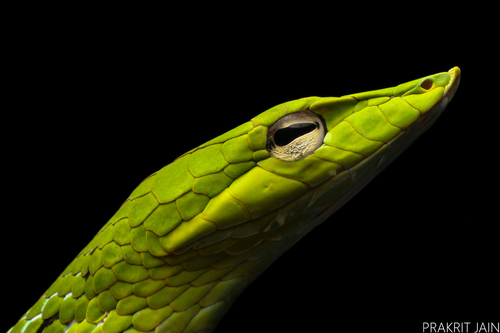
Oriental Whipsnake
Ahaetulla prasina
The master of arboreal disguise, the Oriental Whipsnake is a slender, emerald-green marvel of the Asian canopy. Known for its unique horizontal pupils and swaying movement, it is a fascinating hunter to discover in any backyard forest.
Quick Identification
Size
Total length up to 2 meters (6.5 feet), but extremely slender with a body width often less than a human thumb.
Colors
Typically vibrant leaf-green, though occasionally found in yellow, brown, or grey morphs; white and black checkerboard patterns visible on skin when defensive.
Key Features
- Extraordinarily slender, vine-like body
- Unique horizontal 'keyhole' pupils
- Pointed, spear-shaped snout
- Long, tapering tail used for gripping branches
When You’ll See Them
Geographic range
Where Does the Oriental Whipsnake Live?
The Oriental Whipsnake is native to the vast tropical and subtropical regions of Southern and Southeast Asia. Its core range extends from the eastern Himalayan foothills of India and Bhutan, sweeping across mainland Southeast Asia through Thailand, Vietnam, and Cambodia, and reaching down into the archipelagos of Malaysia, Indonesia, and the Philippines. Because of its ability to adapt to human-altered landscapes, it is a common resident in suburban green belts throughout the Indomalayan realm.
Basemap © OpenStreetMap contributors
Behavior
The Oriental Whipsnake is a highly specialized arboreal hunter, known for its incredible camouflage. Unlike many snakes, it possesses binocular vision, allowing it to accurately judge distances when striking at fast-moving prey. It is frequently observed moving with a curious, rhythmic swaying motion; this behavior mimics a vine blowing in the wind, helping it remain undetected by both its prey and potential predators.
While it is mildly venomous (rear-fanged), this species is generally shy and prefers to flee rather than fight. When cornered, it exhibits a dramatic defensive display: it expands its neck to reveal a striking black-and-white checkered pattern on the skin between its scales and opens its mouth wide to intimidate the threat. They are solitary creatures and are exclusively active during daylight hours, spending their nights coiled tightly among dense foliage.
EverydayEarth exclusive
Camera Tips
To capture the Oriental Whipsnake on camera, focus on verticality. These snakes rarely descend to the ground, so place your cameras at eye level (1.5 to 2 meters) or higher. Aim the lens along horizontal branches, trellises, or the tops of fences where the snake is likely to travel while hunting. Because they are so slender, they may not always trigger traditional PIR (Passive Infrared) sensors; using a camera with high sensitivity or setting a time-lapse mode during peak daylight hours can significantly increase your chances of a sighting.
The best way to 'bait' for a Whipsnake is to attract its prey. Gardens that are lizard-friendly—featuring rock piles, leafy mulch, and flowering plants that attract insects—will naturally draw in these predators. If you have a specific shrub where you often see geckos or garden lizards, that is the prime location for your camera setup. Look for 'corridors' of dense foliage that connect trees, as these are the snake's preferred highways.
Lighting is crucial for this species. Their emerald green scales are beautiful but blend perfectly with leaves. Position your camera so it is not facing directly into the sun, which can wash out the green tones and make the snake look like a shadow. A side-lit or shaded area will help the AI-powered camera pick up the snake's outline against the background. High-resolution video is recommended over still photos to capture their unique swaying 'wind-mimic' movement.
Similar Species
Species that look similar or are commonly confused with Oriental Whipsnake.
Frequently Asked Questions
Record Oriental Whipsnake at your habitat
Connect a camera to start building your own species record — AI identifies every visitor automatically.