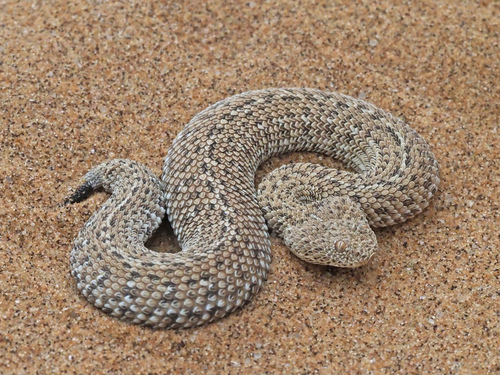
Peringuey's Adder
Bitis peringueyi
The ultimate desert ghost, Peringuey's Adder vanishes into the Namib sands with only its eyes peaking out. It is a master of camouflage that 'swims' through dunes and fishes for lizards with its tail.
Quick Identification
Size
Average length of 20-25 cm (8-10 inches); maximum length rarely exceeds 32 cm (13 inches).
Colors
Sandy brown, grey, or pale buff with three rows of faint dark spots; often features a distinctive black or dark brown tail tip.
Key Features
- Eyes positioned on top of the head
- Sidewinding locomotion
- Small, stocky build with heavily keeled scales
- Black-tipped tail used as a lure
- Blunt snout for burrowing
When You’ll See Them
Geographic range
Where Does the Peringuey's Adder Live?
This specialized viper is native to the Southwestern coast of the African continent. Its core range is concentrated within the Namib Desert, stretching from southern Angola down through the coastal regions of Namibia. It is a true desert specialist, rarely found far from the shifting sand dunes and the influence of the Atlantic's coastal fog belt.
Basemap © OpenStreetMap contributors
Behavior
The Peringuey's Adder is a master of desert survival, famous for its unique 'cratering' behavior. To escape the heat and hide from predators, it wriggles its body sideways to sink into the loose sand, leaving only its upward-facing eyes and the tip of its tail exposed. This allows it to remain virtually invisible while keeping a literal eye out for passing prey or threats.
Its movement is equally specialized; it uses sidewinding locomotion to navigate shifting dunes. By throwing its body in lateral loops, it minimizes contact with the hot sand and prevents slipping on steep slopes. While solitary and generally shy, it is a patient ambush predator that can remain still for hours. If threatened, it may hiss or strike, but it typically relies on its near-perfect camouflage to avoid detection altogether.
EverydayEarth exclusive
Camera Tips
To capture high-quality footage of a Peringuey's Adder, you must place your camera at ground level. These snakes are exceptionally small and low-profile, so an elevated camera will likely miss them entirely. Look for 'slip-faces' on the leeward side of dunes or near the base of small desert shrubs like Nara plants, where their lizard prey often congregates. Identifying the distinctive J-shaped tracks of their sidewinding movement is the best way to know you are in a high-traffic area.
Because these adders are ambush predators that spend hours buried in the sand, standard motion triggers (PIR) can be unreliable. We highly recommend using a 'Time Lapse' setting, programmed to take a photo every 30 to 60 seconds during the peak activity hours of early morning and late afternoon. This increases your chances of catching the snake as it emerges from the sand or performs its fascinating 'caudal luring' (wiggling its tail tip to attract prey).
Since the Namib Desert is a harsh environment, ensure your camera has a sand-proof housing and is secured against the high winds common in dune fields. Placing the camera near a small moisture source, such as a rock where morning fog condenses, can be a great 'natural bait' as these snakes often drink the droplets that accumulate on their own scales. Avoid using strong chemical scents as lures, as these reptiles rely heavily on their specialized heat-sensing and visual cues.
Similar Species
Species that look similar or are commonly confused with Peringuey's Adder.
Horned Adder
The Horned Adder (Bitis caudalis) has prominent horn-like scales above each eye and its eyes are located on the sides of the head rather than the top.
Namaqua Dwarf Adder
This species is even smaller and lacks the specialized dorsal eyes and sidewinding adaptation of the Peringuey's Adder.
Frequently Asked Questions
Record Peringuey's Adder at your habitat
Connect a camera to start building your own species record — AI identifies every visitor automatically.