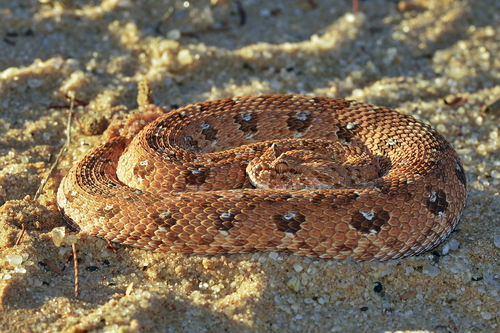
Horned Adder
Bitis caudalis
Meet the master of African desert camouflage. The Horned Adder is a small, sidewinding viper famous for the singular 'horns' above its eyes and its incredible ability to vanish beneath the sand.
Quick Identification
Size
Typically 30-45 cm (12-18 inches) in length; maximum recorded size is approximately 60 cm (24 inches).
Colors
Extremely variable, ranging from sandy grey and pale brown to reddish-orange and even brick red. Features a dorsal pattern of dark, rectangular blotches and a pale belly.
Key Features
- Single prominent, upright horn-like scale over each eye
- Broad, triangular head distinct from the neck
- Stocky, heavy-set body with strongly keeled scales
- Sidewinding locomotion used for moving across loose sand
When You’ll See Them
Geographic range
Where Does the Horned Adder Live?
Africa is the native home of this remarkable viper, specifically the arid southwestern regions of the continent. Its core range is centered in the Namib and Kalahari deserts, spanning across Namibia, Botswana, and the western provinces of South Africa. Populations also extend northward into the dry coastal regions of Angola and eastward into southern Zimbabwe, thriving wherever sandy substrate and sparse vegetation provide adequate cover.
Basemap © OpenStreetMap contributors
Behavior
The Horned Adder is a patient ambush predator, perfectly adapted to the shifting sands of its desert home. It is famous for 'sand-burying,' a behavior where it uses a rhythmic, side-to-side shrugging motion to sink its body beneath the surface. Once submerged, only its eyes, snout, and distinctive horns remain visible, allowing it to stay cool and hidden from both prey and predators for hours or even days at a time.
When moving across the open desert, this species utilizes 'sidewinding,' a specialized lateral movement that minimizes body contact with the scorching sand while allowing for surprising bursts of speed. Although it possesses a potent cytotoxic venom used to subdue prey, the Horned Adder is generally non-aggressive toward humans. If cornered, it will flatten its body, coil into a defensive 'S' shape, and emit a loud, rhythmic hiss to warn off intruders.
EverydayEarth exclusive
Camera Tips
Capturing a Horned Adder on camera requires a ground-level approach. Because these snakes are small and spend much of their time partially buried in the sand, you should mount your AI camera just 5–10 centimeters (2–4 inches) off the ground. Aim the lens at a slight downward angle toward patches of loose sand located near the base of desert shrubs or large rocks, as these are the preferred ambush sites for the species.
One of the biggest challenges with cold-blooded reptiles is triggering the camera. Standard Passive Infrared (PIR) sensors detect heat movement, and since an adder often matches the temperature of the surrounding sand, it might not trigger the shutter. To combat this, use a 'Time-Lapse' or 'Field Scan' mode that takes a photo every 30 to 60 seconds during the peak activity hours of dawn and dusk. This ensures you catch the snake even if it isn't moving enough to trip the sensor.
The Horned Adder's camouflage is its greatest strength, making it nearly invisible in the harsh, flat light of midday. For the best results, focus your monitoring on the 'blue hour' and early night. Use a camera with high-quality 'No-Glow' or 'Black' infrared LEDs. These produce no visible light when the flash triggers, preventing the snake from being startled or its prey from fleeing the area before a strike occurs.
If you are setting up your camera in a backyard or garden within their range, look for the distinctive 'J' shaped tracks left by their sidewinding movement. This is a surefire sign that an adder is in the vicinity. Avoid using food-based lures, as these can attract larger predators like honey badgers or mongooses that might prey on the snake. Instead, place your camera near a known lizard run or a small water source, which naturally attracts the adder's primary food source.
Similar Species
Species that look similar or are commonly confused with Horned Adder.
Frequently Asked Questions
Record Horned Adder at your habitat
Connect a camera to start building your own species record — AI identifies every visitor automatically.