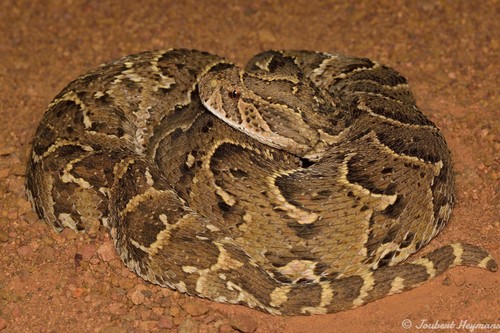
Puff Adder
Bitis arietans
The Puff Adder is Africa's most iconic ambush hunter, masterfully disguised within the leaf litter. Known for its heavy build and lightning-fast strike, it is a fascinating subject for those who want to see the raw power of nature in their own backyard.
Quick Identification
Size
Typically 90-110 cm (3-3.6 ft) in length, though exceptional specimens can reach 190 cm (6.2 ft); weight can reach up to 6 kg (13 lbs) in large adults.
Colors
Dull yellow, light brown, or orange-tan ground color with a series of 18-22 dark, backward-pointing, U- or V-shaped chevrons on the back. Belly is typically yellow or white with occasional dark spots.
Key Features
- Extremely stocky, heavy-bodied build
- Large, triangular head covered in small, keeled scales
- Distinctive dark bands across the eyes and snout
- Short, stubby tail, especially in females
When You’ll See Them
Geographic range
Where Does the Puff Adder Live?
The Puff Adder is native to the African continent and parts of the Arabian Peninsula. It is arguably the most widespread snake in Africa, found from Morocco in the north through the entire sub-Saharan region down to the Cape of South Africa. While they are absent from the hyper-arid Sahara Desert and the densest tropical rainforests of the Congo Basin, they thrive in almost every other environment across the continent.
Basemap © OpenStreetMap contributors
Behavior
The Puff Adder is a classic ambush predator, relying on its incredible camouflage to remain undetected by both prey and threats. Unlike many snakes that flee at the first sign of movement, this viper often remains perfectly still, trusting its cryptic coloration to blend into the leaf litter or dry grass. This behavior is precisely why it is responsible for many snakebites; people often step on them before realizing they are there. When threatened, it inflates its body and emits a loud, terrifying hiss—the 'puff' that gives the species its name.
While they appear sluggish and slow-moving, the Puff Adder possesses one of the fastest strike speeds in the snake world, often hitting its target before the human eye can register the movement. They are primarily solitary and terrestrial, although they are surprisingly capable swimmers and can occasionally be found basking in low bushes. In suburban areas, they are often attracted to the high rodent populations found near homes and barns.
EverydayEarth exclusive
Camera Tips
To capture a Puff Adder on a trail camera, placement is everything. Because they are heavy-bodied and stay low to the ground, your camera should be mounted no more than 15-30 centimeters (6-12 inches) off the ground. If your camera is mounted too high, the PIR sensor may miss the heat signature of a cold-blooded reptile moving through the grass. Wide-angle settings are preferable, as these snakes move slowly until the moment they strike, allowing for excellent detail in the frame.
Focus your efforts on 'ecotones'—the transition zones where tall grass meets a mowed lawn or a dirt path. Puff Adders love to wait at the edges of these clearings where rodents are likely to pass. Another hotspot is near water sources or rocky outcrops where the snakes may bask in the morning sun to regulate their temperature. If you have an AI-powered camera, ensure the sensitivity is set to high; reptiles can be harder to trigger than warm-blooded mammals.
Safety is paramount when checking your equipment. Because the Puff Adder's camouflage is so effective, always use a 'snake stick' or a long tool to clear the area around your camera before reaching for it. Never step blindly into thick leaf litter near your camera site. Using a camera with Wi-Fi or cellular connectivity is highly recommended for this species, as it allows you to view the footage without frequently disturbing the habitat or putting yourself at risk.
Similar Species
Species that look similar or are commonly confused with Puff Adder.
Frequently Asked Questions
Record Puff Adder at your habitat
Connect a camera to start building your own species record — AI identifies every visitor automatically.