Gaboon Viper
Bitis gabonica
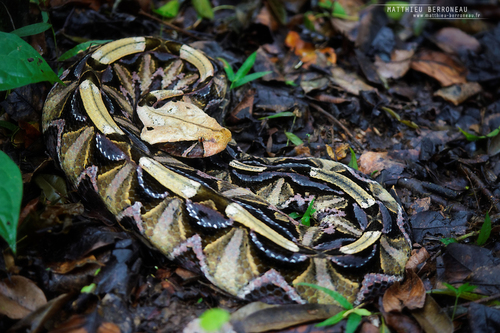
The Gaboon Viper is a master of disguise and the heavyweight champion of the viper world. Featuring nature's most perfect camouflage and the longest fangs on the planet, this African giant is a marvel of evolutionary engineering.
Quick Identification
Size
Typically 120–150 cm (4–5 ft) long, with large specimens reaching 180 cm (6 ft); can weigh up to 8–11 kg (18–25 lbs)
Colors
Complex geometric pattern of buff, purple, pink, and brown rectangles and triangles; head is pale with a dark mid-line and dark spots behind the eyes
Key Features
- Massive, broad triangular head with two small 'horns' on the snout
- Extremely thick, heavy-set body
- Longest fangs of any snake, reaching up to 2 inches (5 cm)
- Intricate 'dead leaf' camouflage pattern
When You’ll See Them
Geographic range
Where Does the Gaboon Viper Live?
The Gaboon Viper is a majestic resident of the sub-Saharan African tropics, making its home primarily in the dense, humid rainforests of Central and West Africa. Its range stretches from the coastal forests of Guinea and Liberia across the vast Congo Basin to the western edges of Kenya and Tanzania. In the southern part of the continent, isolated but stable populations can be found in the moist thickets and forest patches of Zimbabwe, Mozambique, and the KwaZulu-Natal province of South Africa. While they are forest-floor specialists, they occasionally venture into cacao or coffee plantations that mimic their natural shaded habitat.
Basemap © OpenStreetMap contributors
Behavior
The Gaboon Viper is the ultimate ambush predator, relying on its world-class camouflage to remain invisible on the forest floor. Unlike many other vipers that strike and immediately release their prey, the Gaboon Viper often performs a 'strike and hold' maneuver, injecting a massive dose of venom and maintaining its grip until the prey is neutralized. Despite being one of the world's most venomous snakes, they are famously docile and slow-moving, rarely striking at humans unless stepped on or severely provoked.
Primarily nocturnal, these snakes spend their days coiled perfectly still among leaf litter. They use highly sensitive heat-sensing pits located along their upper lips to detect the infrared signatures of warm-blooded prey in total darkness. While they are solitary and sedentary, they can travel surprising distances during the mating season to find a partner, though they spend the vast majority of their lives within a very small home range.
EverydayEarth exclusive
Camera Tips
Since Gaboon Vipers are heavy-bodied ambush predators that spend days or weeks in the exact same spot, traditional motion-trigger cameras can be tricky. To increase your chances, set your camera to 'Time Lapse' mode alongside the PIR motion sensor. This allows you to catch the snake even if it isn't moving enough to trigger the sensor. Position the camera very low—no more than 6 to 10 inches off the ground—angled slightly upward to capture the snake's massive girth and distinctive triangular head against the forest floor.
Lighting is a major factor when filming this species. Use a 'No-Glow' or 'Black Flash' infrared camera to avoid startling the snake or revealing your camera's location to others. Because the Gaboon Viper’s camouflage is so effective, standard daytime photos can look like a simple pile of leaves; nighttime infrared often provides better contrast, highlighting the snake’s thick profile and the bold geometric lines of its scales against the cooler ground.
Focus your efforts on 'pinch points' in the forest—areas where small mammals like giant pouched rats are likely to travel. Fallen logs, the base of large buttress roots, or the edges of game trails are prime real estate for a hungry viper. If you are using a camera in a backyard setting within their native range, ensure the area is clear of heavy debris where you walk, but place the camera near thick leaf litter. Avoid using any chemical lures; instead, rely on the natural presence of prey animals to bring the viper into frame.
Given the extreme toxicity and the record-breaking fang length of the Gaboon Viper, safety is the absolute priority during camera maintenance. Never reach into leaf litter or under a camera housing with your bare hands. Use a long reach tool or 'snake stick' to clear debris from the lens. Check your camera during the day when the snake is least likely to be moving, but remain hyper-aware of your surroundings, as their 'dead leaf' pattern makes them nearly invisible even in broad daylight.
Similar Species
Species that look similar or are commonly confused with Gaboon Viper.
Frequently Asked Questions
Record Gaboon Viper at your habitat
Connect a camera to start building your own species record — AI identifies every visitor automatically.