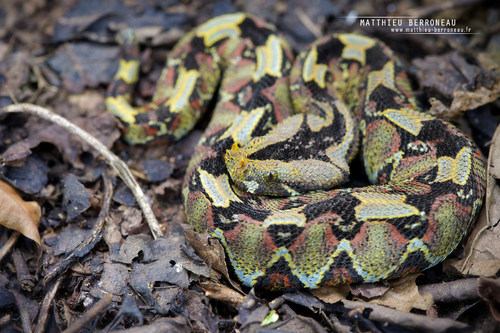
Rhinoceros Viper
Bitis nasicornis
Adorned with a kaleidoscope of geometric patterns and distinctive nasal horns, the Rhinoceros Viper is arguably the most beautiful snake in the African rainforest. This heavy-bodied ambush specialist is a master of disguise, vanishing perfectly into the colorful leaf litter.
Quick Identification
Size
72 to 107 cm (28 to 42 inches) in length, occasionally reaching up to 120 cm (48 inches); heavy-bodied weighing up to 2 kg (4.4 lbs)
Colors
Intricate geometric patterns of velvet-like blue, yellow, red, and brown triangles and rectangles; distinctive black 'arrowhead' on top of the head; belly is dull white to yellow with black/grey spotting
Key Features
- 2-3 pairs of prominent horn-like scales on the tip of the snout
- Broad, triangular head distinct from the thin neck
- Heavy, stout body with rough, keeled scales
- Vibrant 'butterfly' or geometric patchwork coloration
When You’ll See Them
Geographic range
Where Does the Rhinoceros Viper Live?
Native to the lush equatorial regions of the African continent, the Rhinoceros Viper thrives across West and Central Africa. Its core range stretches from the coastal forests of Guinea and Liberia through the Congo Basin to western Kenya and Uganda. It is also found as far south as northern Angola and Zambia, favoring high-rainfall zones where forest cover is dense and humidity remains high throughout the year.
Basemap © OpenStreetMap contributors
Behavior
The Rhinoceros Viper is a master of camouflage, blending seamlessly into the leaf litter of the African rainforest floor. Despite its vibrant colors when viewed in isolation, its disruptive pattern makes it nearly invisible among decaying vegetation. It is primarily terrestrial and a classic ambush predator, often sitting motionless for days waiting for prey to pass within striking distance. When threatened, it is known for a long, sustained hiss that sounds like a leaking valve—a trait shared with its relatives, the puff adders.
While generally slow-moving and placid, it can strike with incredible speed in any direction. Interestingly, this species is more aquatic than many other vipers and is a proficient swimmer. It has also been known to climb low bushes and trees. For humans, they are not naturally aggressive but possess a potent hemotoxic and cytotoxic venom, making them a species to respect from a distance.
EverydayEarth exclusive
Camera Tips
To capture the Rhinoceros Viper on a trail camera, you must focus on the 'micro-habitats' of the forest floor. Position your camera extremely low—no more than 6 to 12 inches off the ground—angled slightly downward toward a clear patch of leaf litter or a known rodent run. Because these snakes are ambush predators, they may stay in the same spot for several days; look for 'sit-and-wait' sites near the base of large buttress trees or near fallen logs which serve as natural funnels for prey.
Using a camera with a high-quality PIR (passive infrared) sensor is crucial, as cold-blooded reptiles don't always trigger sensors designed for warm-blooded mammals. If your camera has a 'Time Lapse' mode, consider setting it to take a photo every 5-10 minutes during the night. This ensures you catch the snake even if it doesn't trigger the motion sensor. Infrared (no-glow) flash is mandatory to avoid spooking the animal or attracting unwanted attention to your gear in the humid jungle environment.
Since they are drawn to water, placing a camera near the edge of a slow-moving stream or a swampy depression can yield great results. There is no need for artificial lures or bait; however, placing the camera near areas with high rodent activity (identified by small holes or runways in the grass) is the most effective natural strategy. Ensure your housing is waterproof and include desiccant packets, as the Rhinoceros Viper's habitat is notoriously humid and prone to fogging lenses.
Similar Species
Species that look similar or are commonly confused with Rhinoceros Viper.
Frequently Asked Questions
Record Rhinoceros Viper at your habitat
Connect a camera to start building your own species record — AI identifies every visitor automatically.