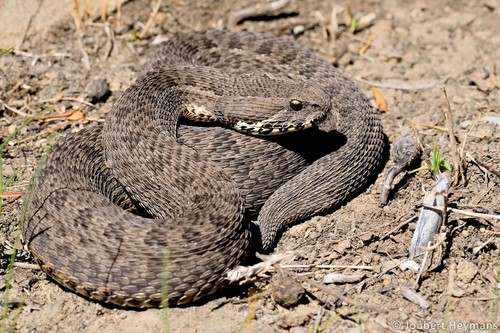
Berg Adder
Bitis atropos
The Berg Adder is the rugged mountaineer of the snake world, perfectly adapted to the thin air and rocky crags of Southern Africa's highest peaks. Though small in stature, its striking geometric patterns and unique neurotoxic venom make it one of the most fascinating reptiles in the region.
Quick Identification
Size
Small and stocky, typically 30–40 cm (12–16 inches) in length, rarely exceeding 60 cm (24 inches).
Colors
Greyish-brown to olive-brown base with two rows of dark, pale-edged semicircular or triangular markings along the back. The belly is usually off-white or grey with dark speckling.
Key Features
- Distinctive triangular head wider than the neck
- Two rows of dark, pale-edged crescent markings along the flanks
- Rough, keeled scales across the body
- Dark teardrop-shaped mark below the eye
When You’ll See Them
Geographic range
Where Does the Berg Adder Live?
Native to the Southern African continent, the Berg Adder is a specialist of high-elevation terrain. Its core range is concentrated in the dramatic peaks of South Africa, stretching from the Cape Fold Mountains through the Drakensberg escarpment and into the high-altitude grasslands of Lesotho. Isolated but stable populations also thrive in the eastern highlands of Zimbabwe and the neighboring border regions of Mozambique, making it a true icon of the region's mountain wilderness.
Basemap © OpenStreetMap contributors
Behavior
The Berg Adder is a famously temperamental species that will not hesitate to hiss loudly or strike if it feels cornered. Unlike many other vipers that rely on heavy camouflage to remain unnoticed, the Berg Adder can be quite bold when basking on mountain paths or rocky outcrops. It is primarily a diurnal hunter, taking advantage of the sun's warmth to fuel its metabolism in the often-chilly montane environments it calls home.
What truly sets this species apart from other members of the Bitis genus, like the Puff Adder, is its venom. While most vipers possess cytotoxic venom that destroys tissue, the Berg Adder has evolved a potent neurotoxic venom. This venom specifically targets the nervous system, potentially causing temporary loss of sight, taste, and smell in humans, as well as respiratory distress. Despite this, they are not naturally aggressive toward humans and prefer to retreat into rock crevices when they feel vibrations from approaching footsteps.
EverydayEarth exclusive
Camera Tips
To capture a Berg Adder on camera, you need to think like a cold-blooded mountaineer. Look for flat, sun-exposed rocks that face north or east (in the Southern Hemisphere) to catch the morning sun. These are 'hot spots' where vipers will spend several hours basking to raise their body temperature before hunting. Position your camera just 10–15 centimeters off the ground, angled slightly downward toward the rock surface. Use a wide-angle lens if possible, as these snakes are small and you'll want to capture the surrounding rocky texture for context.
Since reptiles don't respond to traditional food baits like meat or fruit, your 'lure' is the habitat itself. If you have a rock pile or a stone retaining wall in a montane garden, this is an ideal location. Ensure the area has clear visibility; tall grass can trigger the PIR sensor on windy days, leading to thousands of 'empty' photos. Using a camera with a fast trigger speed (0.3 seconds or less) is vital, as a startled Berg Adder can move surprisingly fast when it decides to retreat into a crevice.
Time of year is critical for success. You are unlikely to see them during the cold winter months (May to August) when they brumate in deep rock fissures. The best footage is usually captured in early spring (September and October) when males are actively searching for mates, or in mid-summer after a light rain, which often brings out the lizards and frogs they prey upon. Set your camera to take a burst of 3-5 photos or a short 10-second video to capture the subtle flicking of the tongue, which is a classic snake behavior.
Similar Species
Species that look similar or are commonly confused with Berg Adder.
Puff Adder
Much larger and thicker body with backwards-pointing chevron markings rather than circular spots.
Rhombic Night Adder
Features a distinct dark 'V' mark on the head and lacks the rough, keeled scales of the Berg Adder.
Horned Adder
Identified by the small 'horns' over the eyes and a preference for more arid, desert environments.
Frequently Asked Questions
Record Berg Adder at your habitat
Connect a camera to start building your own species record — AI identifies every visitor automatically.