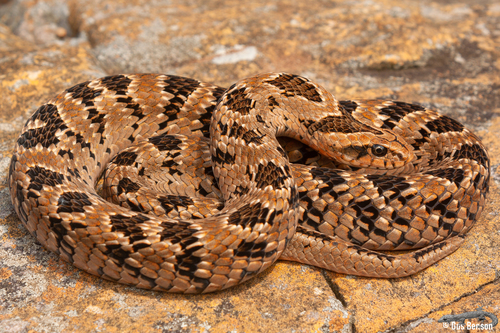
Rhombic Night Adder
Causus rhombeatus
A distinctive toad-hunting specialist recognizable by the bold 'V' on its head, the Rhombic Night Adder is a common but often misunderstood resident of African gardens and grasslands.
Quick Identification
Size
60-90 cm (24-35 inches) in length; rarely exceeds 100 cm (39 inches).
Colors
Pale grey, light brown, or olive-green background with 20-30 dark, rhombic (diamond-shaped) blotches along the back. Cream to yellowish underside.
Key Features
- Distinctive dark 'V' mark on the head with the point between the eyes
- Large, dark diamond-shaped blotches with pale borders along the spine
- Stocky body with a rounded snout and large eyes with round pupils
- Scales are satiny and slightly keeled
When You’ll See Them
Geographic range
Where Does the Rhombic Night Adder Live?
The Rhombic Night Adder is widely distributed across Sub-Saharan Africa, representing one of the continent's most common venomous snakes. Its range extends from the southern tip of South Africa, northward through East Africa into Ethiopia, and westward across the moist savanna belt to Nigeria and parts of West Africa. It is particularly prevalent in regions with high rainfall and plenty of amphibian activity.
Basemap © OpenStreetMap contributors
Behavior
Despite its name, the Rhombic Night Adder is frequently active during the day, particularly in the early morning or late afternoon when it hunts for its favorite prey. They are remarkably fast for an adder and are known to actively pursue their food rather than relying solely on ambush tactics. When threatened, they exhibit a dramatic defensive display: they will hiss loudly, inflate their bodies to appear larger, and may strike repeatedly if further provoked.
In suburban environments, they are surprisingly common because they are attracted to the high populations of toads found in garden ponds. While they are venomous, their venom is primarily cytotoxic and, while painful and causing swelling, it is generally not considered life-threatening to healthy adult humans. They are solitary creatures that spend much of their time hidden in leaf litter, under logs, or in abandoned termite mounds.
EverydayEarth exclusive
Camera Tips
To capture a Rhombic Night Adder on your backyard camera, focus your efforts on the 'amphibian highways.' These snakes are toad specialists, so placing your camera near garden ponds, leaky outdoor taps, or drainage areas is your best bet. Position the camera very low—ideally no more than 10-15 centimeters off the ground—to get a clear profile shot of their distinctive head markings and 'V' shape.
Standard PIR (Passive Infrared) sensors can struggle with cold-blooded reptiles since they rely on heat signatures. To overcome this, use a high-sensitivity setting if your camera allows it, or better yet, use a 'Time Lapse' mode set to take a photo every 30-60 seconds during the early morning and late afternoon. This increases your chances of catching a snake as it slowly cruises through the grass in search of prey.
Lighting is crucial for identification. Night adders have a beautiful satiny sheen that can wash out under heavy flash. If your camera has adjustable IR flash, set it to 'Medium' or 'Low' to avoid overexposing the snake's markings. Since they are active during the day as well, ensure your camera is placed in a spot with dappled shade rather than direct, harsh sunlight, which can create high-contrast shadows that hide the rhombic pattern.
Similar Species
Species that look similar or are commonly confused with Rhombic Night Adder.
Frequently Asked Questions
Record Rhombic Night Adder at your habitat
Connect a camera to start building your own species record — AI identifies every visitor automatically.