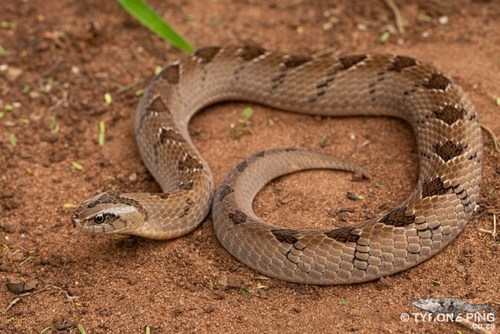
Snouted Night Adder
Causus defilippii
The Snouted Night Adder is a small, charismatic viper recognized by its 'turned-up' nose and bold chevron markings. Frequently found in African gardens, it is a master at hunting amphibians and a fascinating subject for backyard wildlife enthusiasts.
Quick Identification
Size
Average length of 30–40 cm (12–16 inches), rarely exceeding 45 cm (18 inches).
Colors
Grey, light brown, or mauve-grey background with a series of dark brown or black V-shaped markings (chevrons) along the back; belly is yellowish or white with dark speckles.
Key Features
- Distinctly upturned, pointed snout
- Prominent dark V-shape marking on the head with the apex between the eyes
- Short, stocky build with a short tail
- Velvety skin texture from keeled scales
When You’ll See Them
Geographic range
Where Does the Snouted Night Adder Live?
Native to the southeastern regions of the African continent, the Snouted Night Adder thrives in a variety of low-lying and coastal environments. Its core range extends from Kenya and Tanzania in East Africa, southward through Malawi, Zambia, Zimbabwe, and Mozambique. It is particularly common in the northeastern provinces of South Africa, including Limpopo, Mpumalanga, and KwaZulu-Natal, as well as throughout Eswatini.
Basemap © OpenStreetMap contributors
Behavior
The Snouted Night Adder is a terrestrial hunter that, despite its nocturnal name, is often found basking in the sun or hunting during the daylight hours, especially on overcast or humid days. It is known for a spirited defensive display; when cornered, it will puff its body up with air and hiss loudly to appear more intimidating. Unlike many other vipers that tend to be sluggish, this species is relatively quick and agile.
Socially, these snakes are solitary creatures that only interact for mating. They are oviparous, with females typically laying a clutch of 6 to 10 eggs during the summer months. While they are venomous, their venom is not considered lethal to healthy humans, typically causing localized pain and swelling rather than systemic symptoms. However, they are efficient predators of amphibians, using their venom to quickly immobilize frogs and toads.
EverydayEarth exclusive
Camera Tips
To successfully capture a Snouted Night Adder on your backyard camera, you must think low. Because these snakes are small and ground-dwelling, a camera mounted at standard height will likely miss the action entirely. Mount your AI camera no more than 10 centimeters (4 inches) off the ground. Aiming the camera along the base of a wall, a garden border, or a fallen log is ideal, as snakes use these linear features as runways for safe travel.
The best 'bait' for a Snouted Night Adder isn't food you put out, but the environment you create. Positioning your camera near a backyard pond or a consistently damp area will significantly increase your chances of a sighting. These snakes are attracted to the frogs and toads that congregate in moist spots, especially after a summer rainstorm. If you have a garden light that attracts insects (and subsequently toads), that is a prime spot for a camera setup.
Timing is crucial for this species. Set your camera to be most sensitive during the early evening hours and immediately following rain. High-trigger sensitivity is recommended because, while they can be slow, their strikes and defensive lunges are lightning-fast. Ensure the area in front of the lens is clear of tall grass or moving leaves, which can cause false triggers or obscure the snake's intricate chevron patterns and distinctive upturned snout.
Similar Species
Species that look similar or are commonly confused with Snouted Night Adder.
Frequently Asked Questions
Record Snouted Night Adder at your habitat
Connect a camera to start building your own species record — AI identifies every visitor automatically.