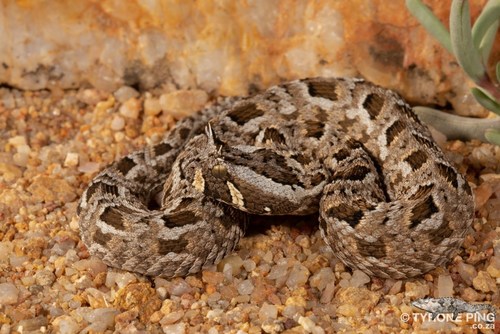
Many-horned Adder
Bitis cornuta
A master of desert deception, the Many-horned Adder is a small but formidable viper adorned with unique scale tufts. Found in the rugged coastal deserts of Southern Africa, it is one of the continent's most visually striking reptiles.
Quick Identification
Size
Typically 30–50 cm (12–20 inches) in length; maximum recorded size is approximately 75 cm (30 inches).
Colors
Variable ground colors of grey, reddish-brown, or sandy-tan, decorated with 3-4 rows of dark, angular blotches with pale edges. The belly is usually a uniform yellowish or dirty white.
Key Features
- Tufts of 2-7 horn-like scales above each eye
- Broad, triangular head distinct from the neck
- Heavily keeled scales giving a rough texture
- Stocky body with a short, tapering tail
When You’ll See Them
Geographic range
Where Does the Many-horned Adder Live?
The Many-horned Adder is native to the southwestern corner of the African continent. Its core range is concentrated along the Atlantic coast, stretching from the Lüderitz region in southwestern Namibia down through the Northern Cape and Western Cape provinces of South Africa. It is a specialist of the winter-rainfall desert regions, thriving in rocky outcrops and sandy plains where coastal fogs provide essential moisture.
Basemap © OpenStreetMap contributors
Behavior
The Many-horned Adder is a sedentary ambush predator that relies heavily on its exceptional camouflage. It is famous for 'cratering,' a behavior where it uses side-to-side body movements to bury itself in loose sand or fine soil. Once submerged, only its eyes and the characteristic horn-like scales remain visible, allowing it to surprise lizards and small mammals that wander too close.
When confronted, this viper is known for its defensive display. It will coil its body into a tight 'S' shape, inflate its lungs to appear larger, and produce a surprisingly loud, raspy hiss. While generally not aggressive if left alone, it will strike readily if stepped on or handled. Its movement is typically a slow crawl, but it can move with more agility across soft sand when necessary.
EverydayEarth exclusive
Camera Tips
To capture the Many-horned Adder on camera, placement is everything. These snakes are extremely low-profile, so your camera should be mounted just 5-10 centimeters (2-4 inches) off the ground. Aim the lens at a slight downward angle toward a patch of sandy soil adjacent to a rock or a small desert shrub. These 'edge' zones are where the snakes are most likely to bury themselves or wait for prey.
Because they are ambush hunters, they may remain in the exact same spot for days. A standard motion-trigger might miss them if they aren't moving, so setting your camera to a time-lapse mode (one photo every 15-30 minutes) can be more effective for documenting their presence. Look for 'tracks' in the sand—small, slightly curved indentations—which indicate where a snake has recently moved or cratered into the soil.
Lighting is a challenge in their bright desert habitat. Position your camera facing south to avoid lens flare from the harsh African sun. These snakes often move during the 'blue hour' of dawn and dusk, so ensure your camera has high-quality infrared (IR) sensors for clear night shots without a visible flash that might startle prey animals in the area. Safety is paramount: always wear snake-proof gaiters or sturdy boots when checking cameras in Many-horned Adder territory, as their camouflage makes them nearly invisible even to the trained eye.
Similar Species
Species that look similar or are commonly confused with Many-horned Adder.
Horned Adder
Possesses only a single horn-like scale over each eye, whereas the Many-horned Adder has a tuft of multiple scales.
Namaqua Dwarf Adder
Much smaller (rarely exceeding 25cm) and typically lacks the prominent raised horns of Bitis cornuta.
Puff Adder
Significantly larger and thicker with chevron-shaped markings; lacks any horn-like scales above the eyes.
Frequently Asked Questions
Record Many-horned Adder at your habitat
Connect a camera to start building your own species record — AI identifies every visitor automatically.